Skip to content
JPLT Online Japanese Language Training SchoolJPLT Online Japanese Language Training School
  • Courses
  • Plans
  • Get Started
    • What is JPLT Metaverse Campus
    • How to Enroll
  • JPLT LEARNING GYM
    • What is JPLT LEARNING GYM?
    • BootCamp
    • Studio
    • Season
    • Grammar Book
    • Optional Classes and AOTD
  • Schedule
  • Blog
  • About Us
    • What Is Dialog+ JPLT
    • Teachers
    • Company Profile
    • Contact Us
    • FAQs
  • Login
  • For Business
JPLT Online Japanese Language Training SchoolJPLT Online Japanese Language Training School
  • Courses
  • Plans
  • Get Started
    • What is JPLT Metaverse Campus
    • How to Enroll
  • JPLT LEARNING GYM
    • What is JPLT LEARNING GYM?
    • BootCamp
    • Studio
    • Season
    • Grammar Book
    • Optional Classes and AOTD
  • Schedule
  • Blog
  • About Us
    • What Is Dialog+ JPLT
    • Teachers
    • Company Profile
    • Contact Us
    • FAQs
  • Login
  • For Business
JPLT Blog

The Difference Between 主語中心の英語と状況中心の日本語の違い の違い |Japanese Grammar (N5–N3)

  • 11 Aug, 2026
  • Com 0
主語中心の英語と状況中心の日本語の違い
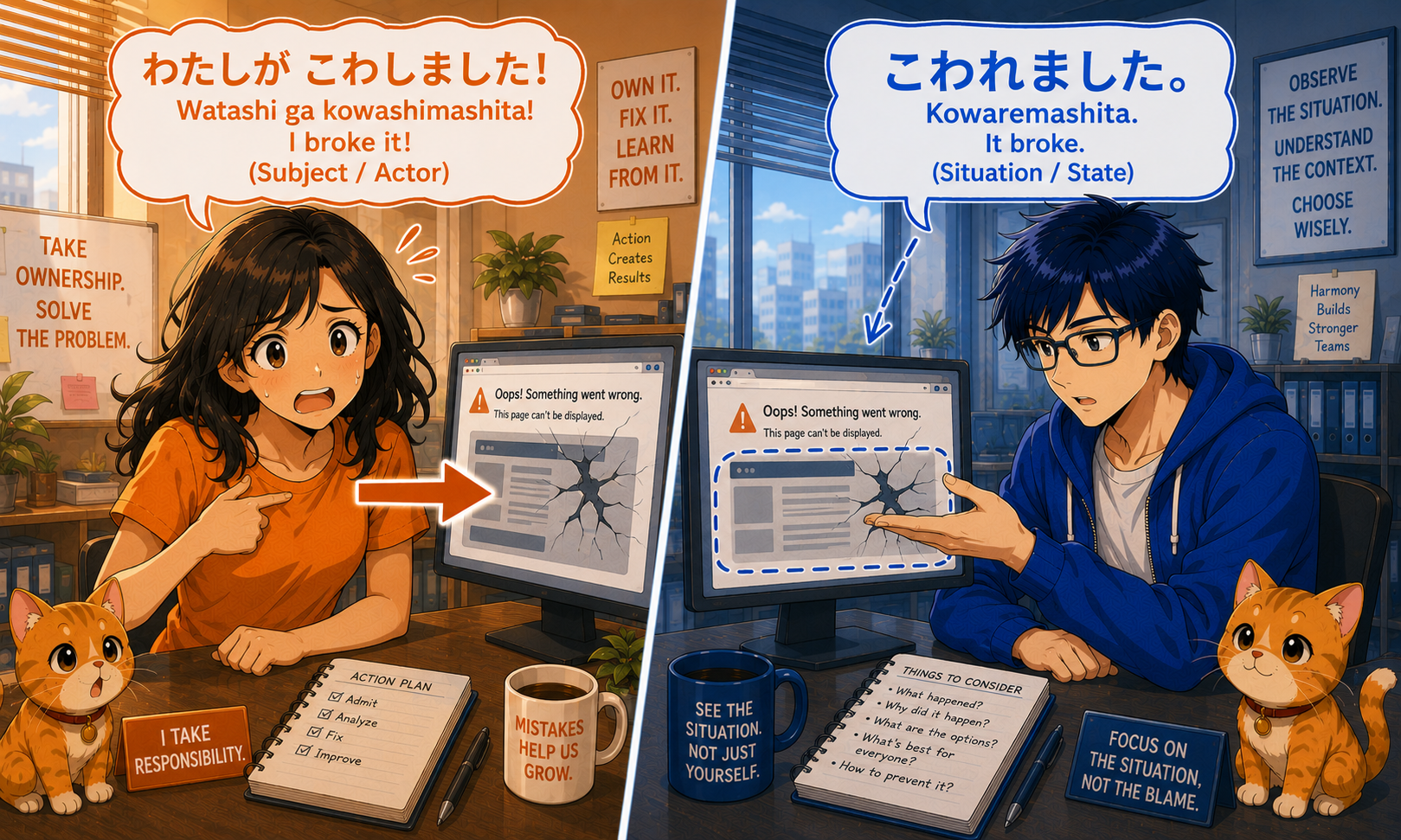
(Alt Text: Joy pointing to herself saying ‘I broke it’ [Subject-Centric] vs. Ken pointing to the screen saying ‘It broke’ [Situation-Centric])

“I dropped my phone.” -> 私が落としました (Subject-centric / English style)
“My phone fell.” -> 落ちてしまいました (Situation-centric / Japanese style)
English is a language obsessed with “Who did it?” Every sentence needs a subject (I, You, He, She). Japanese, however, is a language obsessed with “What happened?” The focus is on the environment, the situation, and the state of things. If you translate English directly into Japanese, you often sound too aggressive, defensive, or strangely dramatic! Let’s see what happens when Joy encounters a technical glitch while managing the school’s web pages.

🗣 Conversation Scene

Joy is updating the student booking page using Elementor. She makes a mistake with the code integration, and the layout gets messed up. She immediately reports it to Director Tanaka.

Joy
ディレクター、すみません!私がエレメンターのレイアウトを壊しました!
(Director, I’m sorry! *I* broke the Elementor layout!)
Tanaka
えっ!?壊した!?わざとですか!?
(Eh!? You broke it!? Did you do it on purpose!?)

[ Tanaka is shocked because Joy’s wording makes it sound like she intentionally smashed the website. Ken steps in. ]

Ken
Joyさん、日本語で「私が壊した」と言うと、犯罪の告白みたいに聞こえます!ビジネスでは「レイアウトが崩れてしまいました」と、状況を報告するんです!
(Joy, saying “I broke it” in Japanese sounds like a crime confession! In business, we report the situation by saying “The layout collapsed [by itself]”!)

💡 Explanation

The Actor vs. The Environment

⚠️ The Core Concept:
English is Subject-centric (Who did what). Japanese is Situation-centric (What state is the environment in). By removing “I” and using Intransitive Verbs (Jidoushi), Japanese people describe accidents objectively without sounding intentionally destructive.

1. The English Way (Subject-Centric) 🎯

In English, saying “I dropped my coffee” or “I lost the file” is normal. It shows accountability. But if you literally translate this to Japanese (*Watashi ga kowashimashita* – I broke it), it strongly implies intent. It sounds like you took a hammer and actively decided to smash the server!

2. The Japanese Way (Situation-Centric) 🌫️

To sound natural in Japanese, you must describe the *scene*, not the *actor*. You do this using Intransitive Verbs (自動詞 – Jidoushi). These are verbs that happen “by themselves.”
Instead of saying “I lost the pen” (Transitive), you say “The pen went missing” (Intransitive). You still start the sentence with “Sumimasen” to apologize, but the description of the problem remains objective.

  • [Reporting a lost file] すみません、データが消えてしまいました。
    (Sorry, the data disappeared. *Natural & Objective*)
  • [Reporting a broken tool] パソコンが壊れてしまいました。
    (The computer broke. *Removes the ‘I did it’ blame*)

3. The Magic Ending: 〜てしまいました (~te shimaimashita) 🪄

To show that the situation was an accident and you feel regret, always add 〜てしまいました (~te shimaimashita) to the end of the verb. This translates to “unfortunately happened” or “happened by accident.”
“Layout ga kuzurete shimaimashita” literally means: “The layout unfortunately collapsed on its own (and I feel bad about it).”

📊 Subject vs. Situation Table

What happened English (Subject-Centric) Japanese (Situation-Centric)
A layout error I broke the layout. レイアウトが崩れてしまいました。
(The layout collapsed.)
A dropped item I dropped my phone. スマホが落ちてしまいました。
(The phone fell.)
A lost item I lost the key. 鍵がなくなってしまいました。
(The key went missing.)

🔥 Practice Quiz

Tap to check the answer!

Q1. You are working in Google Sheets and accidentally delete a row of important data. How do you report this to Tanaka?
A. Sumimasen, watashi ga data wo keshimashita. (I deleted the data).
B. Sumimasen, data ga kieteshimaimashita. (The data disappeared).
Answer: B (Data ga kieteshimaimashita)
Option A sounds like you maliciously sabotaged the Google Sheet on purpose. Option B is the natural way to report an accident.
Q2. Why do Japanese sentences often end with “~te shimaimashita” when reporting a mistake?
A. To blame someone else.
B. To show regret that an accident happened.
Answer: B (To show regret)
It adds the nuance of “unfortunately” or “by accident,” softening the statement and showing that you did not intend for it to happen.


Related posts:

[Must-Read Guide] Recommended Japanese Study Methods for Foreigners Challenges of Learning Japanese: 10 Solutions & Key Points Understanding Gakusei ja nai~n desu and Gakusei ja nai desu Tanoshimi vs Tanoshisa: Understanding their Differences
Share on:
【使い分け】はっきり断る英語とやわらかく断る日本語の違いの違い [日本語学習]
【使い分け】主語中心の英語と状況中心の日本語の違いの違い [日本語学習]
JPLT Malaysia

Japanese Learning Resources:

Tips for Learning Japanese Learn Japanese with Mastery Tips Japanese Grammar Book Japanese Learning Hacks Japanese Learning FAQ (日本語) Japanese Learning FAQ (English)

Connect with us!

Inquire Now!
Send us a message to know the latest class schedules. Lessons are conducted in English and Taglish (Tagalog-English).
Please enable JavaScript in your browser to complete this form.
Name *
Loading

Latest Post

Thumb
【使い分け】主語中心の英語と状況中心の日本語の違いの違い [日本語学習]
11 Aug, 2026
Thumb
The Difference Between 主語中心の英語と状況中心の日本語の違い の違い |Japanese Grammar
11 Aug, 2026
Thumb
【使い分け】はっきり断る英語とやわらかく断る日本語の違いの違い [日本語学習]
11 Aug, 2026

Categories

  • Courses (13)
  • Grammar Book (123)
  • JAPANESE LEARNING FAQ (23)
  • Japanese Learning Hacks (9)
  • Japanese Learning TIPS (197)
  • JPLT Blog (246)
  • JPLT NEWS (12)
  • List of media productions (5)
  • にほんごをまなぶTips (193)
  • 日本語学習ハック (9)
JPLT_logo (2)

JPLT (Japanese language training) online school by Dialogplus 

Icon-facebook Icon-instagram Youtube

株式会社ダイアログプラス(Dialog+ Co., Ltd.) 
神奈川県横浜市都筑区南山田二丁目1番1-206号 
Address: 2-1-1-206 Minamiyamada, Tsuzuki-ku, Yokohama Japan 
Website: https://www.dialogplus.co.jp/ 

Dialog+ Philippines
Philippine Address: Unit 7 2/F, Seung Lee Building, Lot 1 Greenwoods Park Rizal Highway, CBD Area, Subic Bay Freeport Zone, Philippines
Website: https://dialogplus.ph/
Email: info@jplt-dialogplus.com

  • Specified Commercial Transaction Law
  • Privacy Policy
  • Terms & Condition
  • Refund Policy
  • JPLT Calendar
  • Admin
JPLT Online Japanese Language Training SchoolJPLT Online Japanese Language Training School