Skip to content
JPLT Online Japanese Language Training SchoolJPLT Online Japanese Language Training School
  • Courses
  • Plans
  • Get Started
    • What is JPLT Metaverse Campus
    • How to Enroll
  • JPLT LEARNING GYM
    • What is JPLT LEARNING GYM?
    • BootCamp
    • Studio
    • Season
    • Grammar Book
    • Optional Classes and AOTD
  • Schedule
  • Blog
  • About Us
    • What Is Dialog+ JPLT
    • Teachers
    • Company Profile
    • Contact Us
    • FAQs
  • Login
  • For Business
JPLT Online Japanese Language Training SchoolJPLT Online Japanese Language Training School
  • Courses
  • Plans
  • Get Started
    • What is JPLT Metaverse Campus
    • How to Enroll
  • JPLT LEARNING GYM
    • What is JPLT LEARNING GYM?
    • BootCamp
    • Studio
    • Season
    • Grammar Book
    • Optional Classes and AOTD
  • Schedule
  • Blog
  • About Us
    • What Is Dialog+ JPLT
    • Teachers
    • Company Profile
    • Contact Us
    • FAQs
  • Login
  • For Business
JPLT Blog

The Difference Between 直接言う英語と遠回しに言う日本語の違い の違い |Japanese Grammar (N5–N3)

  • 11 Aug, 2026
  • Com 0
直接言う英語と遠回しに言う日本語の違い
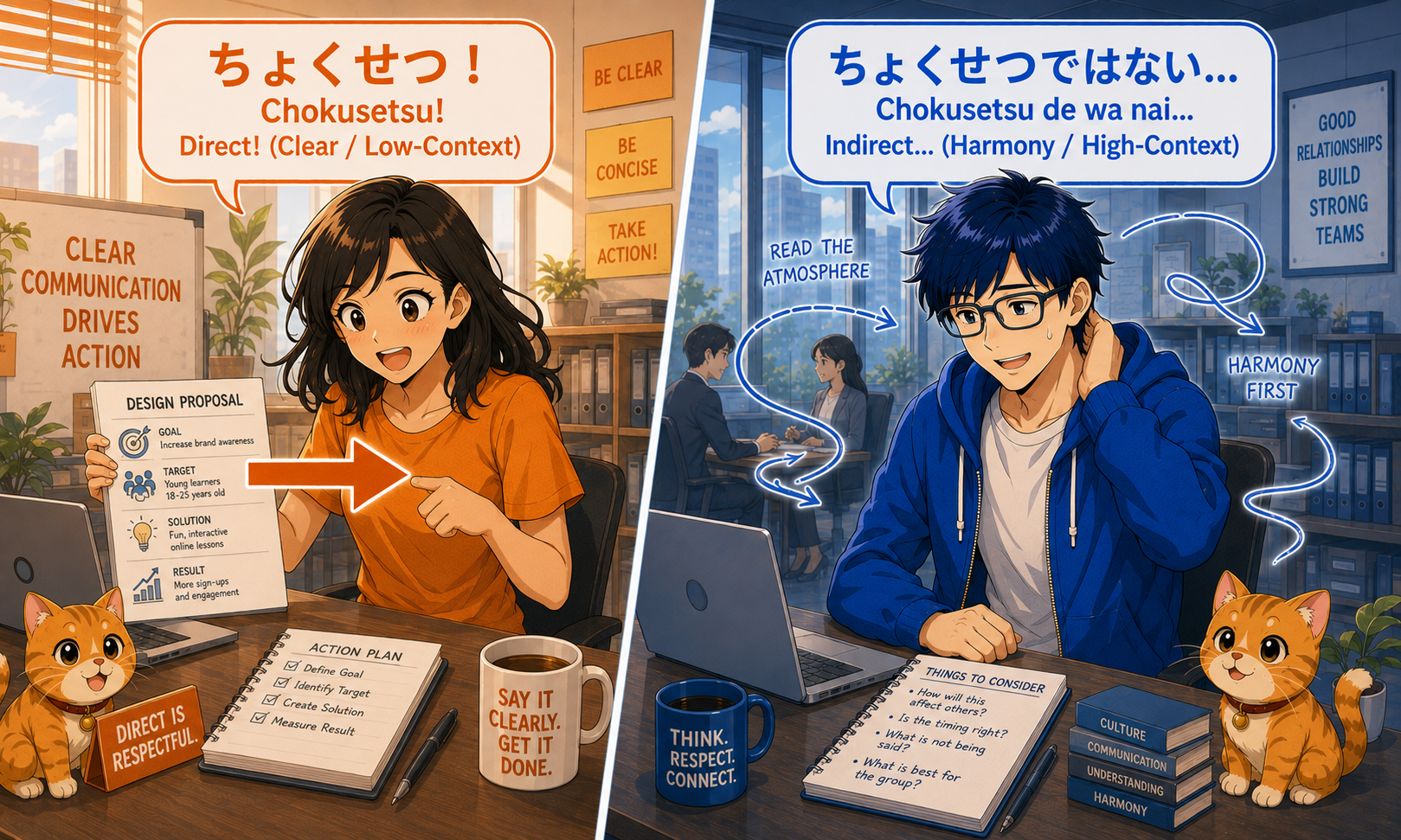
(Joy speaking directly with a straight arrow [Clear/English] vs. Ken smiling politely with a wavy arrow [Harmony/Japanese])

“Please change this color, I don’t like it.” -> Direct (Low-Context / English)
“This is very nice, but the color is a little bit…” -> Indirect (High-Context / Japanese)
One of the biggest culture shocks foreigners experience in Japan is the communication style. In English, being direct is considered polite because it saves time and avoids confusion. In Japanese, being direct is often seen as aggressive or rude. Japanese people use 遠回し (Toomawashi – Indirect expression) to protect harmony. Let’s see what happens when Joy submits a new visual communication design to Director Tanaka.

🗣 Conversation Scene

Joy has just finished creating the visual materials for tomorrow’s social media campaign and shows them to Director Tanaka.

Joy
ディレクター、明日のSNS用のビジュアルデザインが完成しました!いかがですか?
(Director, the visual design for tomorrow’s SNS is finished! How is it?)
Tanaka
お疲れ様。デザインは綺麗ですね。ただ、文字の色がちょっと……
(Good work. The design is pretty. However, the text color is a little bit…)
Joy
ありがとうございます!では、このままアップロードしますね!
(Thank you! I will upload it as is then!)

[ Tanaka panics. Ken quickly stops Joy. ]

Ken
Joyさん、ストップ!日本のビジネスで「ちょっと……」は「NG(やり直し)」という意味ですよ!空気を読んで!
(Joy, stop! In Japanese business, “a little bit…” means “NG (No Good / Redo it)”! Read the air!)

💡 Explanation

Clarity vs. Harmony (Low-Context vs. High-Context)

⚠️ The Core Concept:
English is a Low-Context language: Politeness comes from being clear and not wasting people’s time. Japanese is a High-Context language: Politeness comes from preserving harmony (Wa – 和) and avoiding direct confrontation.

1. The English Way (Directness) 🎯

In English business culture, if a design needs changing, a good boss will say, “Change the text color, it’s hard to read.” This is considered helpful and efficient. In Japan, stating negative feedback this directly sounds like you are angry or attacking the creator’s personal ability.

2. The Japanese Way (Indirectness / Toomawashi) 🌫️

To avoid hurting feelings, Japanese people use 遠回し (Toomawashi – beating around the bush). Instead of saying “No,” they leave the sentence unfinished or use vague words, trusting that you will “read the air” (Kuuki wo yomu) and understand the true meaning.

  • それはちょっと…… (Sore wa chotto…)
    Literal: That is a little bit…
    True Meaning: No / I disagree / Please change it.
  • 難しいかもしれません (Muzukashii kamoshiremasen)
    Literal: It might be difficult.
    True Meaning: It is impossible / We cannot do it.

📊 The Translation of “No”

What They Say Literal Meaning What They Actually Mean
いいえ (Iie) “No.” Almost never used in business. Too harsh.
〜はちょっと…
(~wa chotto…)
“~ is a little bit…” “No.” or “I don’t like it.” (Standard polite refusal)
検討します
(Kentou shimasu)
“I will consider it.” “No / We won’t do it.” (Used to politely reject a sales pitch)

💎 The “Sandwich” Technique

If you *must* give negative feedback in Japan, always use the Sandwich Technique.
1. Praise (The bread): “The layout is great.”
2. Indirect Critique (The meat): “But the font is *a little bit…*”
3. Soft landing (The bread): “What do you think?”

🔥 Practice Quiz

Tap to check the answer!

Q1. You propose a new marketing idea to a client. They smile and say, “Kento shimasu” (We will consider it). What should you do?
A. Wait for them to call you back next week.
B. Understand it’s a polite “No” and move on.
Answer: B (Understand it’s a polite “No”)
In Japanese business, “Kento shimasu” is the standard indirect way to reject a proposal without saying “No” to your face.
Q2. A coworker asks if you can work overtime tonight. You have dinner plans. How do you refuse politely?
A. Iie, dekimasen! (No, I cannot!)
B. Sumimasen, kyou wa chotto… (Sorry, today is a little bit…)
Answer: B (Sumimasen, kyou wa chotto…)
Leaving the sentence unfinished with “chotto…” allows the coworker to “read the air” and understand you are busy, preserving harmony.


Related posts:

[Must-Read Guide] Recommended Japanese Study Methods for Foreigners Challenges of Learning Japanese: 10 Solutions & Key Points Understanding Gakusei ja nai~n desu and Gakusei ja nai desu Tanoshimi vs Tanoshisa: Understanding their Differences
Share on:
GrammarBook: Verb (plain form) + のに (Even though / Although [Verb])
【使い分け】直接言う英語と遠回しに言う日本語の違い の違い [日本語学習]
JPLT Malaysia

Japanese Learning Resources:

Tips for Learning Japanese Learn Japanese with Mastery Tips Japanese Grammar Book Japanese Learning Hacks Japanese Learning FAQ (日本語) Japanese Learning FAQ (English)

Connect with us!

Inquire Now!
Send us a message to know the latest class schedules. Lessons are conducted in English and Taglish (Tagalog-English).
Please enable JavaScript in your browser to complete this form.
Name *
Loading

Latest Post

Thumb
【使い分け】主語中心の英語と状況中心の日本語の違いの違い [日本語学習]
11 Aug, 2026
Thumb
The Difference Between 主語中心の英語と状況中心の日本語の違い の違い |Japanese Grammar
11 Aug, 2026
Thumb
【使い分け】はっきり断る英語とやわらかく断る日本語の違いの違い [日本語学習]
11 Aug, 2026

Categories

  • Courses (13)
  • Grammar Book (123)
  • JAPANESE LEARNING FAQ (23)
  • Japanese Learning Hacks (9)
  • Japanese Learning TIPS (197)
  • JPLT Blog (246)
  • JPLT NEWS (12)
  • List of media productions (5)
  • にほんごをまなぶTips (193)
  • 日本語学習ハック (9)
JPLT_logo (2)

JPLT (Japanese language training) online school by Dialogplus 

Icon-facebook Icon-instagram Youtube

株式会社ダイアログプラス(Dialog+ Co., Ltd.) 
神奈川県横浜市都筑区南山田二丁目1番1-206号 
Address: 2-1-1-206 Minamiyamada, Tsuzuki-ku, Yokohama Japan 
Website: https://www.dialogplus.co.jp/ 

Dialog+ Philippines
Philippine Address: Unit 7 2/F, Seung Lee Building, Lot 1 Greenwoods Park Rizal Highway, CBD Area, Subic Bay Freeport Zone, Philippines
Website: https://dialogplus.ph/
Email: info@jplt-dialogplus.com

  • Specified Commercial Transaction Law
  • Privacy Policy
  • Terms & Condition
  • Refund Policy
  • JPLT Calendar
  • Admin
JPLT Online Japanese Language Training SchoolJPLT Online Japanese Language Training School