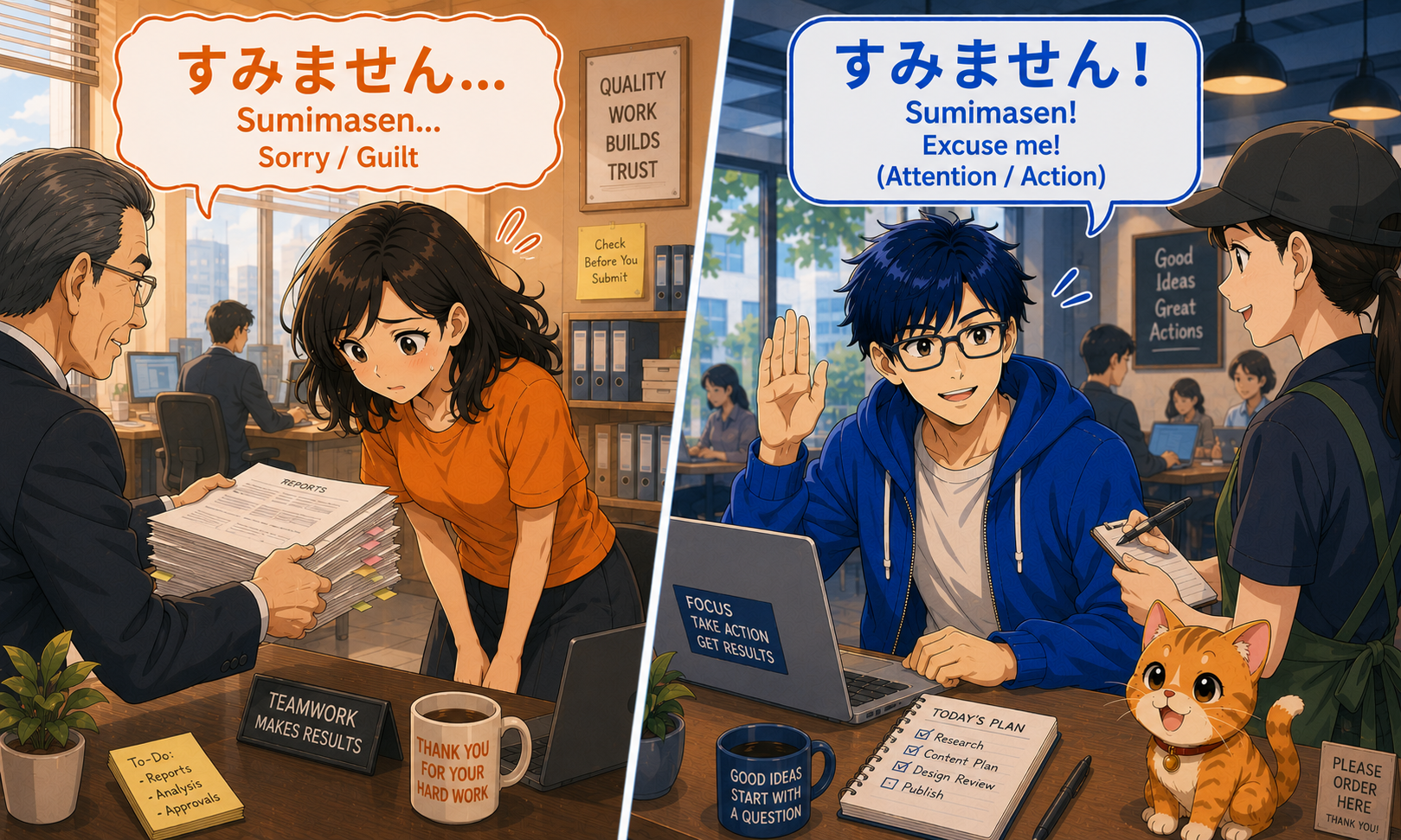
(Joy looking guilty saying Sumimasen [Apology focus] vs. Ken raising his hand politely saying Excuse me [Attention focus])
“Excuse me, waiter!” -> すみません (Sumimasen)
“I’m sorry I bumped into you.” -> すみません (Sumimasen)
“Thank you for picking up my pen.” -> すみません (Sumimasen)
すみません (Sumimasen) is the ultimate Swiss Army knife of the Japanese language. While textbooks translate it as “Excuse me,” it is also used for apologies and, surprisingly, for gratitude! However, if you rely on it too much, you will sound like you are constantly apologizing for your existence. Let’s see what happens when Director Tanaka helps Joy with a task.
🗣 Conversation Scene
Joy dropped a large stack of design documents on the floor. Director Tanaka stops to help her pick them up.
(Are you okay? I’ll help you. Here you go.)
(Ahhh! Director, “Sumimasen!” [I’m so sorry!] Really, “Sumimasen!”)
[ Tanaka smiles and walks away. Ken gives Joy a helpful tip. ]
(Joy, Japanese people also use “Sumimasen” when someone is kind to them, but saying “Arigatou gozaimasu” [Thank you] makes both people feel much happier!)
💡 Explanation
The Three Faces of Sumimasen
すみません (Sumimasen) is used whenever your actions interrupt another person’s space or time. This is why it works for getting attention, apologizing, and showing gratitude!
1. “Excuse me” (Calling Out) 🙋
When you need to get a waiter’s attention, or when you are trying to push through a crowded train, you are taking up someone’s time or space. “Sumimasen” is the perfect, polite tool for this.
- [At a restaurant] すみません、注文をお願いします!
(Excuse me, I’d like to order!) - [On a crowded train] すみません、降ります!
(Excuse me, I’m getting off!)
2. “I’m sorry” (Light Apology) 🙏
If you accidentally bump into someone, or if you are a few minutes late, “Sumimasen” acts as a light apology. However, do not use it for massive business failures! If you make a huge mistake that costs the company money, “Sumimasen” sounds too casual. You must use 申し訳ございません (Moushiwake gozaimasen).
- [Bumping shoulders in the hall] あ、すみません!
(Ah, sorry!)
3. The “Sorry-Thank You” (Gratitude) 🎁
In Japanese culture, noticing the effort someone put into helping you is highly polite. When you drop your pen and someone picks it up, native speakers often say “Sumimasen” to mean: “I am sorry you had to use your energy to help me, and I appreciate it.”
The Trap: Because beginners hear Japanese people saying “Sumimasen” constantly, they forget to say “Arigatou” (Thank you). If you always say “Sumimasen,” your communication becomes very negative and guilty. Try to upgrade your “Sorry-Thank You” to a positive ありがとうございます (Arigatou gozaimasu) to brighten the office mood!
📊 Comparison Table
🔥 Practice Quiz
Tap to check the answer!