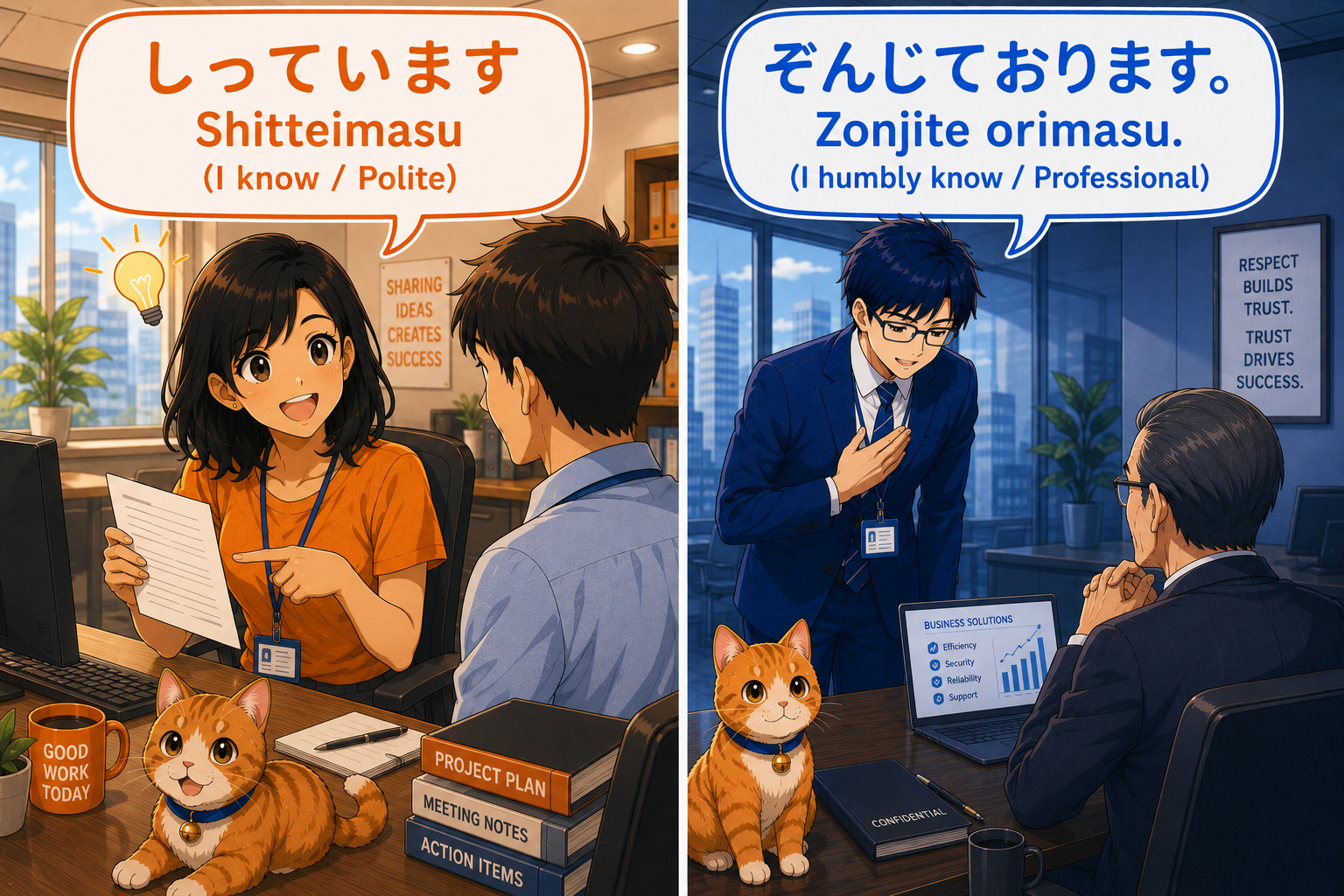
 (Joy confidently saying Shitteimasu to a coworker [Polite] vs. Ken humbly saying Zonjite orimasu to a boss [Humble])
“I know the meeting time.” (To a coworker) -> 知っています。 (Polite) “I know the client’s background.” (To a boss) -> 存じております。 (Humble) In Japanese business, acknowledging what you know is a daily occurrence. As a Studio Season 1 student, you have learned to use 知っています (Shitteimasu). However, when talking to a strict boss or an important client, standard politeness is not enough. You must actively lower your own status using Humble Language (Kenjougo) by switching to 存じております (Zonjite orimasu). Let’s see what happens when Director Tanaka asks Joy a question.
🗣 Conversation Scene
Director Tanaka is asking Joy if she is familiar with the new VIP client visiting tomorrow.Tanaka
Joyさん、明日いらっしゃるA社の鈴木社長のことは知っていますか?
(Joy, do you know about President Suzuki of Company A who is visiting tomorrow?)
Joy
はい、知っています! ニュースで見ました。
(Yes, I know [“Shitteimasu”]! I saw him in the news.)
[ Ken pulls Joy aside to help her upgrade her business vocabulary. ]
Ken
Joyさん、上司に答える時は「知っています」ではなく、「存じております」を使うと、大人っぽくて謙虚なビジネス日本語になりますよ。
(Joy, when answering a boss, using “Zonjite orimasu” instead of “Shitteimasu” makes your business Japanese humble and mature.)
💡 Explanation
Standard Polite vs. Humble Language⚠️ The Golden Rule of Knowledge:
When talking about your own knowledge, 知っています (Shitteimasu) is neutral and polite. Changing it to 存じております (Zonjite orimasu) actively lowers your status to elevate the listener, which is required for high-level respect.
1. 知っています (Shitteimasu) = Polite (Teineigo) ☕
Target: Coworkers, standard office situations, junior staff. This is standard polite language. It is perfectly respectful for everyday office life when talking to team members or people of similar rank. However, because it treats the listener as an equal, it can sound a bit unrefined or too casual when speaking to a high-ranking director or a VIP client.- [To a coworker] はい、そのニュースは知っています。 (Yes, I know that news. *Standard Polite*)
2. 存じております (Zonjite orimasu) = Humble (Kenjougo) 👔
Target: Bosses, clients, customers, formal emails. “Zonjite orimasu” is the humble form of knowing, combined with the extra polite “orimasu”. By using it, you are grammatically lowering yourself. This is the absolute standard for business emails, answering the phone, and reporting to bosses.- [To a client on the phone] はい、御社の新製品については存じております。 (Yes, I am humbly aware of your new product. *Professional/Humble*)
- [When you don’t know] 申し訳ありません、存じ上げません。 (I am sorry, I humbly do not know. *Zonjiagemasen is the negative form*)
📊 Comparison Table
🚧 The “Do You Know?” Trap
Remember that humble language (Kenjougo) is only used for your own actions. You can say “Watashi wa zonjite orimasu” (I know). But you must never use it to ask the boss a question! If you ask a client, “Zonjite orimasu ka?” (Do you humbly know?), you are grammatically pushing the client into the dirt! To ask a boss or client if *they* know something, you must use Respectful language (Sonkeigo): ご存知ですか (Gozonji desu ka).🔥 Practice Quiz
Tap to check the answer!Keep practicing in Studio Season 1!