Skip to content
JPLT Online Japanese Language Training SchoolJPLT Online Japanese Language Training School
  • Courses
  • Plans
  • Get Started
    • What is JPLT Metaverse Campus
    • How to Enroll
  • JPLT LEARNING GYM
    • What is JPLT LEARNING GYM?
    • BootCamp
    • Studio
    • Season
    • Grammar Book
    • Optional Classes and AOTD
  • Schedule
  • Blog
  • About Us
    • What Is Dialog+ JPLT
    • Teachers
    • Company Profile
    • Contact Us
    • FAQs
  • Login
  • For Business
JPLT Online Japanese Language Training SchoolJPLT Online Japanese Language Training School
  • Courses
  • Plans
  • Get Started
    • What is JPLT Metaverse Campus
    • How to Enroll
  • JPLT LEARNING GYM
    • What is JPLT LEARNING GYM?
    • BootCamp
    • Studio
    • Season
    • Grammar Book
    • Optional Classes and AOTD
  • Schedule
  • Blog
  • About Us
    • What Is Dialog+ JPLT
    • Teachers
    • Company Profile
    • Contact Us
    • FAQs
  • Login
  • For Business
JPLT Blog

The Difference Between 「すぐ」と「ただいま」の会社での使い分け の違い |Japanese Grammar (N5–N3)

  • 14 Jul, 2026
  • Com 0
「すぐ」と「ただいま」の会社での使い分け
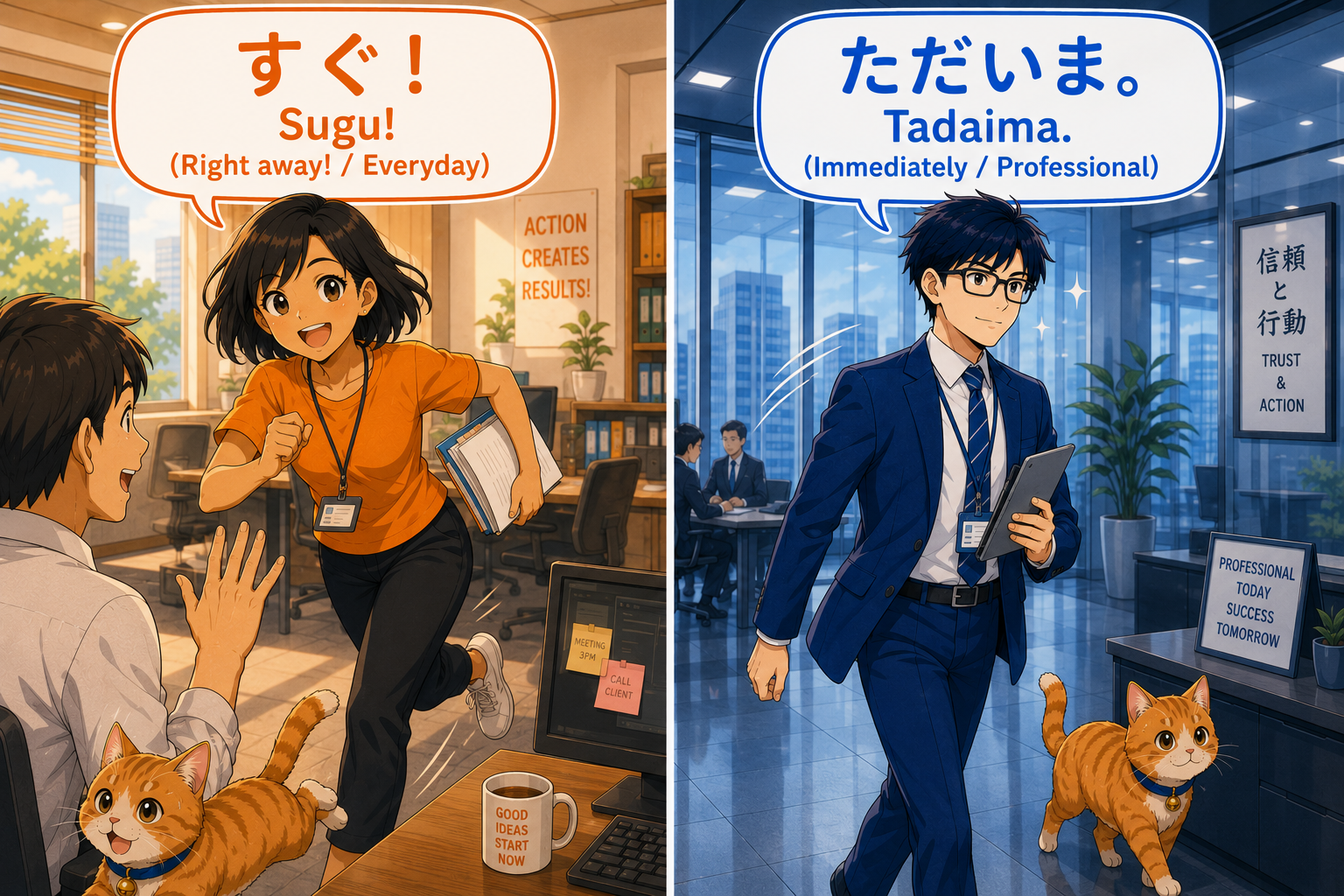
(Joy jogging energetically saying Sugu [Casual] vs. Ken walking elegantly saying Tadaima [Professional])

“I’ll go right away!” (To a coworker) -> すぐ行きます! (Standard Polite)
“I will be right there.” (To a boss/client) -> ただいま参ります。 (Professional / Elegant)
When someone calls your name, you want to show that you will respond quickly. In daily life, すぐ (Sugu) is the perfect word. But in a Japanese business setting, “Sugu” can sound a little bit raw or childish. To show true professional polish, you need to use ただいま (Tadaima). Let’s see what happens when Joy is called by her manager.

🗣 Conversation Scene

Director Tanaka needs Joy’s help with a document and calls her from across the room.

Tanaka
Joyさん、ちょっとここに来てくれますか?
(Joy, could you come here for a second?)
Joy
はい、すぐ行きます!
(Yes, I’ll go “sugu” [right away]!)

[ Ken whispers to Joy to help her sound more professional. ]

Ken
Joyさん、上司には「すぐ行きます」よりも、「ただいま参ります」の方が、大人っぽくてプロフェッショナルに聞こえますよ!
(Joy, to a boss, saying “Tadaima mairimasu” sounds much more mature and professional than “Sugu ikimasu”!)

💡 Explanation

Everyday Urgency vs. Business Elegance

⚠️ The Golden Rule of Immediacy:
すぐ (Sugu) focuses on the speed of the action (casual/standard). ただいま (Tadaima) focuses on the present moment and adds an elegant, professional wall of respect.

1. すぐ (Sugu) = Right away / Soon 👟

Target: Coworkers, daily life, friends.
“Sugu” is perfectly fine for everyday situations and working with people of the same rank. However, because it is an everyday word, using it with a high-level boss or an important client makes you sound a bit like a student responding to a teacher. It lacks corporate polish.

  • [To a coworker] すぐやります!
    (I’ll do it right away! *Energetic but standard*)
  • [On a casual team chat] すぐ送ります。
    (I’ll send it soon. *Standard office use*)

2. ただいま (Tadaima) = Immediately / Currently 🏢

Target: Bosses, clients, customers, VIPs.
Written with the kanji 只今, it literally means “right now.” When used for future actions (“I will go right now”), it sounds incredibly elegant and respectful. It is almost always paired with Humble Language (Kenjougo). It is also heavily used in customer service (e.g., “Tadaima kakunin itashimasu” – I am checking right now).

  • [When called by a boss] ただいま参ります。
    (I will be right there. *Highest respect*)
  • [To a client waiting] ただいまお持ちいたします。
    (I will bring it immediately. *Professional service*)

📊 Comparison Table

Word Nuance Who to use it with
すぐ
(Sugu)
Standard Urgency. Focuses on speed and action. Coworkers, friends, everyday situations.
ただいま
(Tadaima)
Professional Urgency. Elegant and respectful. Bosses, clients, customers (often with Kenjougo).

🚧 The “I’m Home” Trap

You probably learned that ただいま (Tadaima) is what you say when you arrive home (“I’m home!”). Because of this, beginners sometimes walk back into their office after a meeting and happily shout, “Tadaima!” Do not do this! Your office is not your house. When returning to the office, you should say 戻りました (Modorimashita – I have returned).

🔥 Practice Quiz

Tap to check the answer!

Q1. A very important client calls you. They want you to check a file, but you need 30 seconds to open it. What do you say?
A. Sugu kakunin shimasu.
B. Tadaima kakunin itashimasu.
Answer: B (Tadaima kakunin itashimasu)
When speaking with a client, you must use the highly professional “Tadaima” combined with humble verbs.
Q2. A coworker from your team asks if you can send them a link on Slack.
A. Hai, sugu okurimasu!
B. Hai, tadaima o-okuri itashimasu.
Answer: A (Sugu okurimasu!)
With a close team member on chat, “Tadaima” is too stiff and overly formal. “Sugu” is perfect here.
Keep practicing with JPLT!


Related posts:

[Must-Read Guide] Recommended Japanese Study Methods for Foreigners Challenges of Learning Japanese: 10 Solutions & Key Points Understanding Gakusei ja nai~n desu and Gakusei ja nai desu Tanoshimi vs Tanoshisa: Understanding their Differences
Share on:
【使い分け】「あとで」と「後ほど」のビジネス表現の違い の違い [日本語学習]
【使い分け】「すぐ」と「ただいま」の会社での使い分け の違い [日本語学習]
JPLT Malaysia

Japanese Learning Resources:

Tips for Learning Japanese Learn Japanese with Mastery Tips Japanese Grammar Book Japanese Learning Hacks Japanese Learning FAQ (日本語) Japanese Learning FAQ (English)

Connect with us!

Inquire Now!
Send us a message to know the latest class schedules. Lessons are conducted in English and Taglish (Tagalog-English).
Please enable JavaScript in your browser to complete this form.
Name *
Loading

Latest Post

Thumb
【使い分け】「できます」と「可能です」のフォーマル度の違い の違い [日本語学習]
14 Jul, 2026
Thumb
The Difference Between 「できます」と「可能です」のフォーマル度の違い の違い |Japanese Grammar
14 Jul, 2026
Thumb
【使い分け】「確認します」と「確認いたします」の敬語の違い の違い [日本語学習]
14 Jul, 2026

Categories

  • Courses (13)
  • Grammar Book (108)
  • JAPANESE LEARNING FAQ (23)
  • Japanese Learning Hacks (9)
  • Japanese Learning TIPS (181)
  • JPLT Blog (213)
  • JPLT NEWS (12)
  • List of media productions (5)
  • にほんごをまなぶTips (176)
  • 日本語学習ハック (9)
JPLT_logo (2)

JPLT (Japanese language training) online school by Dialogplus 

Icon-facebook Icon-instagram Youtube

株式会社ダイアログプラス(Dialog+ Co., Ltd.) 
神奈川県横浜市都筑区南山田二丁目1番1-206号 
Address: 2-1-1-206 Minamiyamada, Tsuzuki-ku, Yokohama Japan 
Website: https://www.dialogplus.co.jp/ 

Dialog+ Philippines
Philippine Address: Unit 7 2/F, Seung Lee Building, Lot 1 Greenwoods Park Rizal Highway, CBD Area, Subic Bay Freeport Zone, Philippines
Website: https://dialogplus.ph/
Email: info@jplt-dialogplus.com

  • Specified Commercial Transaction Law
  • Privacy Policy
  • Terms & Condition
  • Refund Policy
  • JPLT Calendar
  • Admin
JPLT Online Japanese Language Training SchoolJPLT Online Japanese Language Training School