Skip to content
JPLT Online Japanese Language Training SchoolJPLT Online Japanese Language Training School
  • Courses
  • Plans
  • Get Started
    • What is JPLT Metaverse Campus
    • How to Enroll
  • JPLT LEARNING GYM
    • What is JPLT LEARNING GYM?
    • BootCamp
    • Studio
    • Season
    • Grammar Book
    • Optional Classes and AOTD
  • Schedule
  • Blog
  • About Us
    • What Is Dialog+ JPLT
    • Teachers
    • Company Profile
    • Contact Us
    • FAQs
  • Login
  • For Business
JPLT Online Japanese Language Training SchoolJPLT Online Japanese Language Training School
  • Courses
  • Plans
  • Get Started
    • What is JPLT Metaverse Campus
    • How to Enroll
  • JPLT LEARNING GYM
    • What is JPLT LEARNING GYM?
    • BootCamp
    • Studio
    • Season
    • Grammar Book
    • Optional Classes and AOTD
  • Schedule
  • Blog
  • About Us
    • What Is Dialog+ JPLT
    • Teachers
    • Company Profile
    • Contact Us
    • FAQs
  • Login
  • For Business
Japanese Learning TIPS

What is the difference between ‘が’ and ‘は’ in Japanese?

  • 15 May, 2024
  • Com 0
What is the difference between 'が' and 'は' (2)
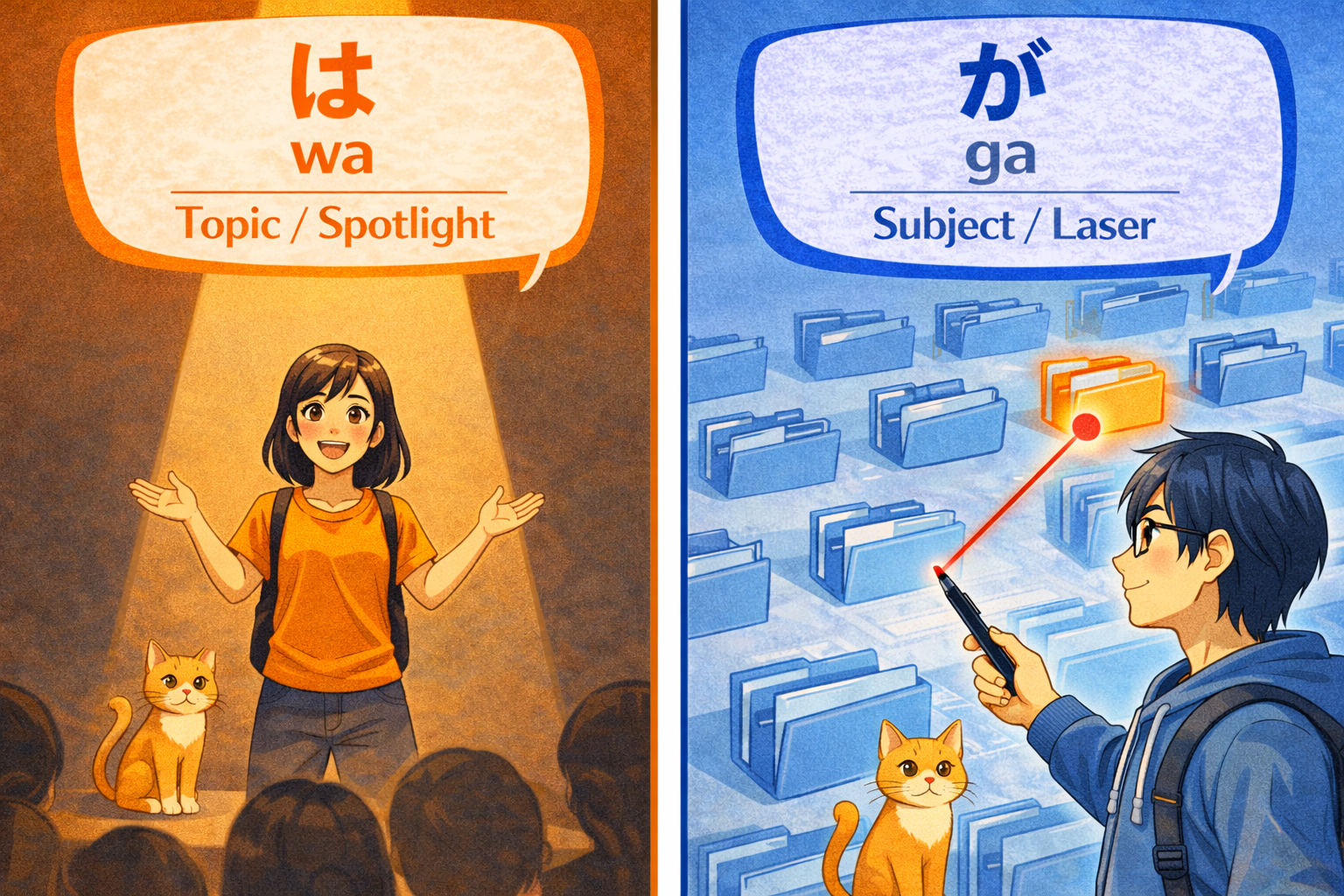
(Joy standing under a broad spotlight introducing a topic [Wa] vs. Ken using a laser pointer to identify a specific item [Ga])

“As for me, I am a student.” -> Watashi wa gakusei desu.
“I am the student (not someone else).” -> Watashi ga gakusei desu.
The difference between は (Wa) and が (Ga) is considered the biggest hurdle in Japanese grammar. While both might seem to mark the subject in English translations, they serve entirely different functions. “Wa” acts as a broad spotlight introducing a topic, while “Ga” acts as a pinpoint laser pointer identifying a specific subject. Let us look at how Joy and Ken apply this concept.

[ Conversation Scene ]

Joy and Ken are walking in the park when they notice a dog.

Joy
ケンさん、あの犬を見てください。あの犬はとてもかわいいですね。
(Ken, please look at that dog. “Ano inu wa” [As for that dog], it is very cute.)
Ken
本当だ。でも、気をつけてください。あの犬の目が少し怖いです。
(True. But please be careful. “Ano inu no me ga” [Specifically, the eyes of that dog] are a little scary.)

[ Explanation ]

The Spotlight vs. The Laser Pointer

1. は (Wa) = The Broad Spotlight

Focus: What comes AFTER the particle.
“Wa” introduces a general topic. It tells the listener, “Speaking of this topic, here is some information about it.” The listener already knows the topic exists; the most important information is what you say about it afterward.

  • 私は学生です。
    (As for me, I am a student. *The new information is “student”*)
  • 肉は好きですが、魚は嫌いです。
    (Speaking of meat, I like it; speaking of fish, I dislike it. *Used for contrast*)

2. が (Ga) = The Exact Laser Pointer

Focus: What comes BEFORE the particle.
“Ga” identifies a specific subject. It tells the listener, “This specific thing is the one doing the action.” It is used to point out a culprit, report a new discovery, or answer a “who/what” question.

  • 私が学生です。
    (I am the one who is the student. *The important information is “I”*)
  • 雨が降ってきました。
    (Rain is falling. *Reporting a sudden, new discovery in front of you*)

[ Comparison Table ]

Particle Visual Concept Where is the Focus?
は (Wa) Broad Spotlight After the particle (The description).
が (Ga) Laser Pointer Before the particle (The subject itself).

[ Caution: The Question Word Rule ]

Because “Wa” places the focus on the end of the sentence, you can never attach it to a question word (who, what, which). The question word itself is the most important information to identify, so it must take “Ga”.

[ Incorrect ]: 誰は来ますか。
(This is grammatically impossible.)

[ Correct ]: 誰が来ますか。
(Who is the one coming?)

[ Practice Quiz ]

Tap to check the answer.

Q1. A teacher enters a noisy room and asks: “What happened?”
(Nani ______ atta n desu ka.)
Answer: が (Ga)
The question word “Nani” (What) must be followed by “Ga” to identify the unknown subject.
Q2. Looking at a beautiful mountain, you say: “Speaking of that mountain, it is beautiful.”
(Ano yama ______ kirei desu ne.)
Answer: は (Wa)
You are introducing the broad topic of the mountain to describe it.


Related posts:

How can I Find an Online Japanese Language Tutor? Can’t Find the Words During Online Japanese Lessons? Causes and Solutions Explained Present vs. Past “Thank You”: When to Use Each Form Understanding the Subtle Differences Between ‘Iku nara’ and ‘Iku no nara’
Share on:
[必見]格安で早く話せるオンライン日本語スクールは?
[Must-see] Which affordable Filipino online Japanese school can help you learn to speak quickly?
JPLT Malaysia

Japanese Learning Resources:

Tips for Learning Japanese Learn Japanese with Mastery Tips Japanese Grammar Book Japanese Learning Hacks Japanese Learning FAQ (日本語) Japanese Learning FAQ (English)

Connect with us!

Inquire Now!
Send us a message to know the latest class schedules. Lessons are conducted in English and Taglish (Tagalog-English).
Please enable JavaScript in your browser to complete this form.
Name *
Loading

Latest Post

Thumb
【使い分け】「また」はいつ使う?あいまい表現の落とし穴 の違い [日本語学習]
01 Apr, 2026
Thumb
The Difference Between 「また」はいつ使う?あいまい表現の落とし穴 の違い |Japanese Grammar
01 Apr, 2026
Thumb
【使い分け】「ちょっと」は数量?それとも断り?使い分けのコツ の違い [日本語学習]
30 Mar, 2026

Categories

  • Courses (17)
  • Grammar Book (74)
  • JAPANESE LEARNING FAQ (23)
  • Japanese Learning Hacks (9)
  • Japanese Learning TIPS (156)
  • JPLT Blog (174)
  • JPLT NEWS (12)
  • List of media productions (5)
  • にほんごをまなぶTips (153)
  • 日本語学習ハック (9)
JPLT_logo (2)

JPLT (Japanese language training) online school by Dialogplus 

Icon-facebook Icon-instagram Youtube

株式会社ダイアログプラス(Dialog+ Co., Ltd.) 
神奈川県横浜市都筑区南山田二丁目1番1-206号 
Address: 2-1-1-206 Minamiyamada, Tsuzuki-ku, Yokohama Japan 
Website: https://www.dialogplus.co.jp/ 

Dialog+ Philippines
Philippine Address: Unit 7 2/F, Seung Lee Building, Lot 1 Greenwoods Park Rizal Highway, CBD Area, Subic Bay Freeport Zone, Philippines
Website: https://dialogplus.ph/
Email: info@jplt-dialogplus.com

  • Specified Commercial Transaction Law
  • Privacy Policy
  • Terms & Condition
  • Refund Policy
  • JPLT Calendar
  • Admin
JPLT Online Japanese Language Training SchoolJPLT Online Japanese Language Training School