Skip to content
JPLT Online Japanese Language Training SchoolJPLT Online Japanese Language Training School
  • Courses
  • Plans
  • Get Started
    • What is JPLT Metaverse Campus
    • How to Enroll
  • JPLT LEARNING GYM
    • What is JPLT LEARNING GYM?
    • BootCamp
    • Studio
    • Season
    • Grammar Book
    • Optional Classes and AOTD
  • Schedule
  • Blog
  • About Us
    • What Is Dialog+ JPLT
    • Teachers
    • Company Profile
    • Contact Us
    • FAQs
  • Login
  • For Business
JPLT Online Japanese Language Training SchoolJPLT Online Japanese Language Training School
  • Courses
  • Plans
  • Get Started
    • What is JPLT Metaverse Campus
    • How to Enroll
  • JPLT LEARNING GYM
    • What is JPLT LEARNING GYM?
    • BootCamp
    • Studio
    • Season
    • Grammar Book
    • Optional Classes and AOTD
  • Schedule
  • Blog
  • About Us
    • What Is Dialog+ JPLT
    • Teachers
    • Company Profile
    • Contact Us
    • FAQs
  • Login
  • For Business
JPLT Blog

The Difference Between「〜です」と「〜だ」のフォーマル度の違い の違い |Japanese Grammar (N5–N3)

  • 26 Jun, 2026
  • Com 0
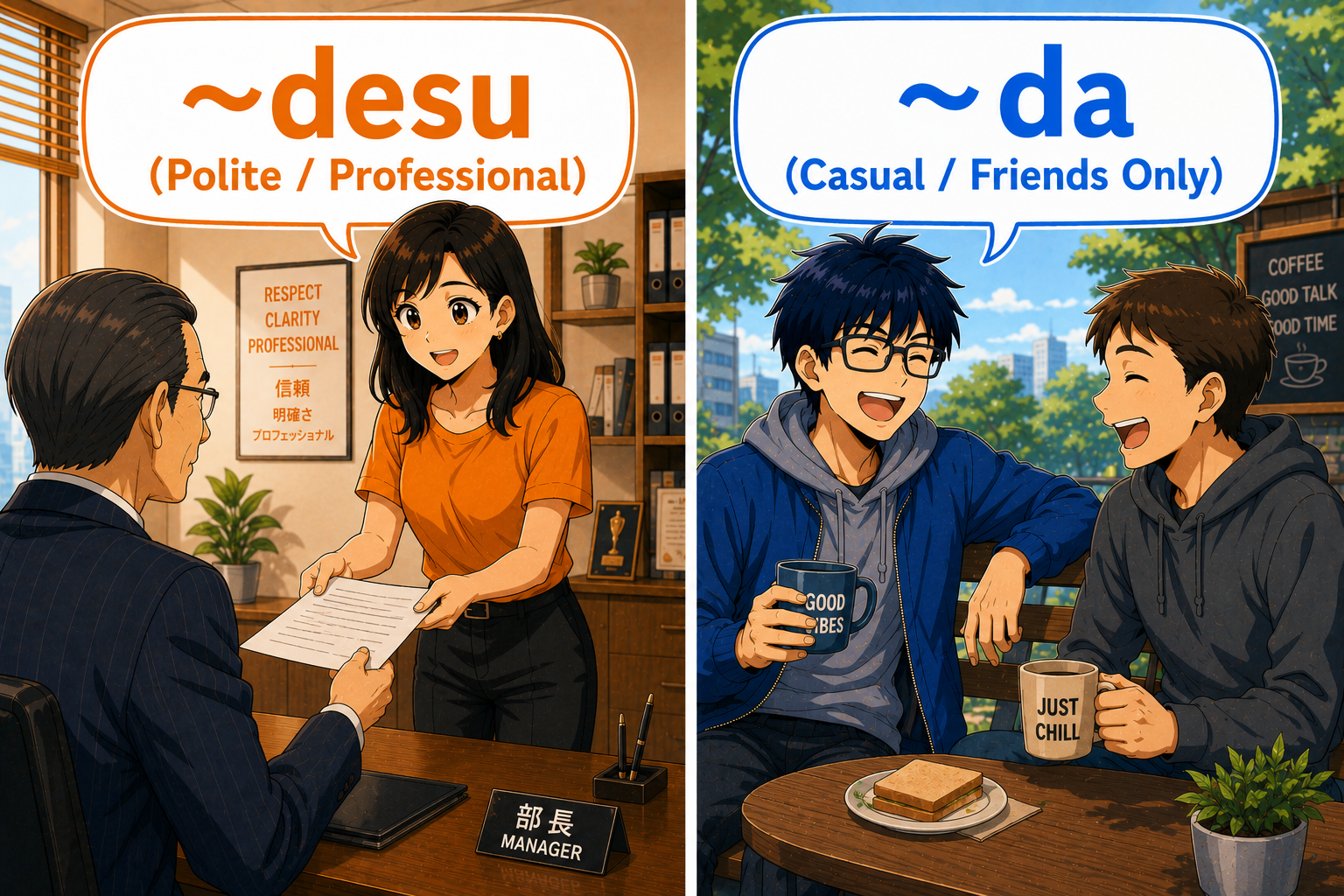
「〜です」と「〜だ」のフォーマル度の違い (Joy speaking politely with a boss using ~desu [Professional] vs. Ken chatting casually with a friend using ~da [Casual])

“This is a book.” (To a teacher) -> Kore wa hon desu. (Polite) “This is a book.” (To a friend) -> Kore wa hon da. (Casual) At their core, both 〜です (~desu) and 〜だ (~da) mean “it is” or “I am.” However, Japanese grammar is deeply tied to social hierarchy. Using the wrong form doesn’t just make your sentence grammatically incorrect—it can actually offend the person you are talking to! Let’s watch what happens when Joy mixes up her formality levels at the office.

🗣 Conversation Scene

Joy is handing a very important report to Director Tanaka.
Joy
ディレクター、明日の会議のレポートだ! (Director, here “da” [it is] the report for tomorrow’s meeting!)
Tanaka
……レポート「だ」? 私たちは友達じゃないですよ、Joyさん。 (…Report “da”? We are not friends, Joy. *Sighs*)

[ Ken quickly helps Joy correct her mistake. ]

Ken
Joyさん、会社では「です」を使いましょう!「だ」を使うと、タメ口(友達言葉)になってしまいます! (Joy, you must use “desu” at the company! If you use “da”, it becomes “tameguchi” [casual friend talk]!)

💡 Explanation

The Wall of Politeness
⚠️ The Golden Rule of Desu vs. Da: 〜です (~desu) puts up a polite wall between you and the listener. 〜だ (~da) tears that wall down completely.

1. 〜です (~desu) = Polite / Professional 🏢

Target: Strangers, Coworkers, Bosses, Staff. This is the standard “Polite Form” (Teineigo) taught in textbooks. It shows that you respect the social distance between yourself and the listener. As a foreign learner, you should use `~desu` 90% of the time, especially when you are out in public or at work.
  • [To a store clerk] 私はアメリカ人です。 (I am American. *Polite*)
  • [To a boss] 明日は火曜日です。 (Tomorrow is Tuesday. *Professional*)

2. 〜だ (~da) = Casual / Intimate 🏠

Target: Family, Close Friends, Talking to yourself. This is the “Plain Form” (Short Form). It completely removes the social wall. While it is great for building intimacy with your best friends, using it with someone older or of higher status sounds like you are treating them like a child or a drinking buddy.
  • [To your best friend] 私はアメリカ人だ。 (I am American. *Casual*)
  • [To yourself/muttering] あ、明日は火曜日だ。 (Ah, tomorrow is Tuesday. *Talking to oneself*)

📊 Comparison Table

Word Formality Level Who to use it with
〜です (~desu) Polite (Long Form) Maintains a respectful wall. Superiors, strangers, teachers, coworkers.
〜だ (~da) Casual (Short Form) Zero boundaries. Best friends, family members, or talking to yourself.

🚧 The “News Article” Trap

If you read a Japanese newspaper or a Wikipedia article, you will notice that almost every sentence ends in 〜だ (~da) or 〜である (~dearu). This does not mean the writer is being rude! In written Japanese, the plain form is used to state objective facts. However, in spoken conversation, using “~da” carries the strong emotion of casual intimacy.

🔥 Practice Quiz

Tap to check the answer!
Q1. You are asking a police officer for directions. You want to point to a building and say, “Is it that building?” A. Ano tatemono da? B. Ano tatemono desu ka?
Answer: B (~desu ka?) A police officer is a stranger, so you must use the polite form.
Q2. You are having drinks with your best friend from college. You want to say, “I am sleepy.” A. Nemui da. (Or just “Nemui”) B. Nemui desu.
Answer: A (Casual Form) Using “desu” with your best friend while drinking will make you sound very stiff and distant!
Keep practicing with JPLT!
 

    JPLT Online School

    Learn Japanese with JPLT Online School


    Want to study Japanese in a more guided and beginner-friendly way?
    Feel free to contact us and we’ll help you find the right course for your level and goal.


    We’re happy to help you start your Japanese learning journey with confidence.

    Related posts:

    [Must-Read Guide] Recommended Japanese Study Methods for Foreigners What Are Differences Between Formal and Informal Japanese? Learning Japanese Requests: When to Use ‘Onegaishimasu’ vs. ‘Kudasai’ Default ThumbnailExperience the Charm of Japanese Food! Enjoyable Dishes and Eating Tips for Beginners
    Share on:
    【使い分け】 「本当?」と「本当ですか?」初心者が迷う違い の違い [日本語学習]
    JPLT Malaysia

    Japanese Learning Resources:

    Tips for Learning Japanese Learn Japanese with Mastery Tips Japanese Grammar Book Japanese Learning Hacks Japanese Learning FAQ (日本語) Japanese Learning FAQ (English)

    Connect with us!

    Inquire Now!
    Send us a message to know the latest class schedules. Lessons are conducted in English and Taglish (Tagalog-English).
    Please enable JavaScript in your browser to complete this form.
    Name *
    Loading

    Latest Post

    Thumb
    The Difference Between「〜です」と「〜だ」のフォーマル度の違い の違い |Japanese Grammar (N5–N3)
    26 Jun, 2026
    Thumb
    【使い分け】 「本当?」と「本当ですか?」初心者が迷う違い の違い [日本語学習]
    24 Jun, 2026
    Thumb
    The Difference Between 「本当?」と「本当ですか?」初心者が迷う違い の違い |Japanese Grammar
    24 Jun, 2026

    Categories

    • Courses (18)
    • Grammar Book (108)
    • JAPANESE LEARNING FAQ (23)
    • Japanese Learning Hacks (9)
    • Japanese Learning TIPS (170)
    • JPLT Blog (191)
    • JPLT NEWS (12)
    • List of media productions (5)
    • にほんごをまなぶTips (165)
    • 日本語学習ハック (9)
    JPLT_logo (2)

    JPLT (Japanese language training) online school by Dialogplus 

    Icon-facebook Icon-instagram Youtube

    株式会社ダイアログプラス(Dialog+ Co., Ltd.) 
    神奈川県横浜市都筑区南山田二丁目1番1-206号 
    Address: 2-1-1-206 Minamiyamada, Tsuzuki-ku, Yokohama Japan 
    Website: https://www.dialogplus.co.jp/ 

    Dialog+ Philippines
    Philippine Address: Unit 7 2/F, Seung Lee Building, Lot 1 Greenwoods Park Rizal Highway, CBD Area, Subic Bay Freeport Zone, Philippines
    Website: https://dialogplus.ph/
    Email: info@jplt-dialogplus.com

    • Specified Commercial Transaction Law
    • Privacy Policy
    • Terms & Condition
    • Refund Policy
    • JPLT Calendar
    • Admin
    JPLT Online Japanese Language Training SchoolJPLT Online Japanese Language Training School