
Skip to content
JPLT Online Japanese Language Training SchoolJPLT Online Japanese Language Training School
  • Courses
  • Plans
  • Get Started
    • What is JPLT Metaverse Campus
    • How to Enroll
  • JPLT LEARNING GYM
    • What is JPLT LEARNING GYM?
    • BootCamp
    • Studio
    • Season
    • Grammar Book
    • Optional Classes and AOTD
  • Schedule
  • Blog
  • About Us
    • What Is Dialog+ JPLT
    • Teachers
    • Company Profile
    • Contact Us
    • FAQs
  • Login
  • For Business
JPLT Online Japanese Language Training SchoolJPLT Online Japanese Language Training School
  • Courses
  • Plans
  • Get Started
    • What is JPLT Metaverse Campus
    • How to Enroll
  • JPLT LEARNING GYM
    • What is JPLT LEARNING GYM?
    • BootCamp
    • Studio
    • Season
    • Grammar Book
    • Optional Classes and AOTD
  • Schedule
  • Blog
  • About Us
    • What Is Dialog+ JPLT
    • Teachers
    • Company Profile
    • Contact Us
    • FAQs
  • Login
  • For Business
Japanese Learning TIPS

The Difference Between “ほど” and “くらい/ぐらい”

  • 22 Aug, 2024
  • Com 0
The Difference Between ほど and くらいぐらい
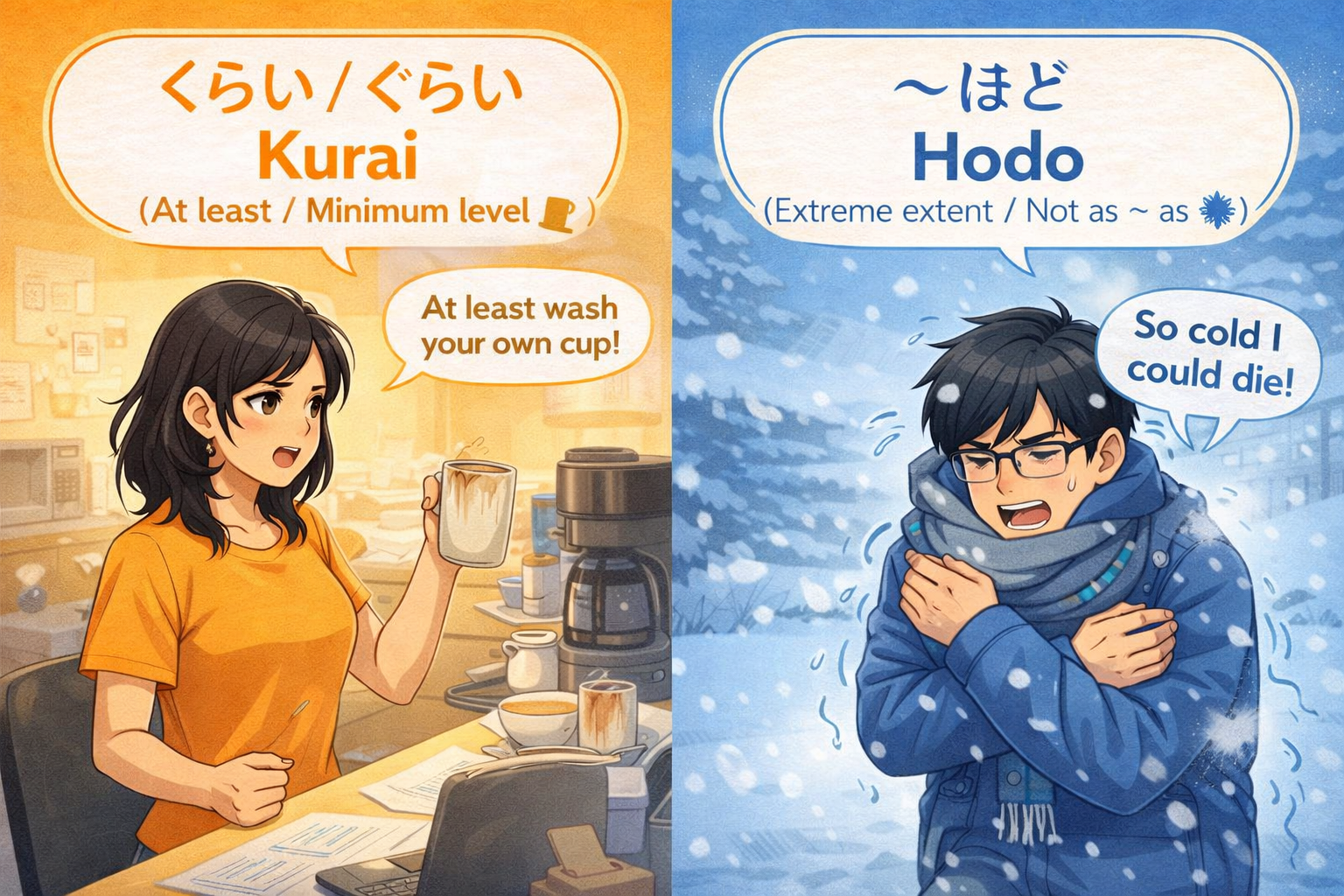
(Joy asking Ken to ‘at least’ wash a cup [Kurai] vs. Ken shivering from extreme cold [Hodo])

“At least wash your cup.” -> Koppu kurai aratte.
“Today is not as cold as yesterday.” -> Kinou hodo samukunai.
“I’m so tired I could die.” -> Shinu hodo / Shinu kurai tsukareta.
When Japanese learners want to express “to the extent of” or “about,” they often mix up ほど (hodo) and くらい/ぐらい (kurai/gurai). Sometimes they mean the exact same thing, but other times, using the wrong one will break the sentence! Let’s clear up the rules with Joy and Ken.

🗣 Conversation Scene

Joy and Ken are in the JPLT office breakroom during a very cold winter day.

Joy
ケンさん、またコーヒーのコップをそのままにしていますね!
自分のコップ くらい 洗(あら)ってください!

(Ken, you left your coffee cup again! You should “kurai” [at least] wash your own cup!)
Ken
ご、ごめんなさい!でも今日は、手が凍(こお)る ほど 寒(さむ)いんですよ〜!
(S-sorry! But today is so cold “hodo” [to the extent that] my hands are freezing!)

💡 Explanation

Minimum Level vs. Negative Comparison

1. くらい / ぐらい (Kurai / Gurai) = At least (Minimum Level)

Exclusive to Kurai: When you want to express a minimum standard or something that should be very easy/basic, you MUST use “kurai”. You cannot use “hodo” here.

  • 挨拶(あいさつ)くらい してください。
    (At least say hello. *Minimum expectation*)
  • ひらがな くらい 読めます。
    (I can read at least Hiragana. *Basic level*)

2. ほど (Hodo) = Not as ~ as ~ (Negative Comparison)

Exclusive to Hodo: When you compare two things and say “A is NOT AS [adjective] AS B,” you MUST use “hodo + negative verb”. You cannot use “kurai” here.

  • 今日は 昨日 ほど 寒くない。
    (Today is not as cold as yesterday.)
  • 私は 彼 ほど 日本語が上手じゃない。
    (I am not as good at Japanese as he is.)

3. Both: Extent / Degree (To the point of…)

When expressing an extreme extent or degree, BOTH can be used. However, “hodo” sounds slightly more formal or extreme.

  • 死ぬ ほど 疲れた。 / 死ぬ くらい 疲れた。
    (I am so tired I could die. *Both OK!*)
  • 涙(なみだ)が出る ほど 嬉しい。 / 涙が出る くらい 嬉しい。
    (I am so happy I could cry. *Both OK!*)

📊 Quick Cheat Sheet

Usage / Meaning くらい (Kurai) ほど (Hodo)
Minimum Level (At least)
e.g., At least clean up
✅ YES ❌ NO
Negative Comparison (Not as…as)
e.g., Not as hot as yesterday
❌ NO ✅ YES
Extreme Extent
e.g., So delicious I could cry
✅ YES (Casual) ✅ YES (Formal/Extreme)

🚧 The Scolding Trap!

If you get angry and tell someone to do the bare minimum, don’t use “hodo”!

❌ Wrong: 自分の部屋 ほど 掃除(そうじ)してよ!
(Nuance: You are using an extreme word for a minimum task. It sounds like gibberish.)

✅ Right: 自分の部屋 くらい 掃除してよ!
(Nuance: “At least clean your own room!” Very natural.)

🔥 Practice Quiz

Tap to check the answer!

Q1. This year is not as hot as last year.
(Kotoshi wa kyonen ______ atsukunai.)
Answer: hodo (ほど)
Negative comparison ALWAYS uses “hodo”.
Q2. If you are going to be late, you should at least contact me!
(Okurēru nara, renraku ______ shite kudasai!)
Answer: kurai / gurai (くらい/ぐらい)
It is a minimum expectation or basic action.
Q3. I laughed so much my stomach hurts!
(Onaka ga itaku naru ______ waratta!)
Answer: kurai OR hodo (くらい / ほど)
Both are correct because it expresses an extreme degree!
Keep practicing with JPLT!


Related posts:

[Must-Read Guide] Recommended Japanese Study Methods for Foreigners What Are Differences Between Formal and Informal Japanese? Are Online Japanese Lessons Effective? Explaining the Causes and Solutions Understanding the Subtle Differences Between ‘Iku nara’ and ‘Iku no nara’
Share on:
「友達」と「友人」の違い [日本語学習]
The Difference Between "大人向け" and "大人向き"
JPLT Malaysia

Japanese Learning Resources:

Tips for Learning Japanese Learn Japanese with Mastery Tips Japanese Grammar Book Japanese Learning Hacks Japanese Learning FAQ (日本語) Japanese Learning FAQ (English)

Connect with us!

Inquire Now!
Send us a message to know the latest class schedules. Lessons are conducted in English and Taglish (Tagalog-English).
Please enable JavaScript in your browser to complete this form.
Name *
Loading

Latest Post

Thumb
【使い分け】「また」はいつ使う?あいまい表現の落とし穴 の違い [日本語学習]
01 Apr, 2026
Thumb
The Difference Between 「また」はいつ使う?あいまい表現の落とし穴 の違い |Japanese Grammar
01 Apr, 2026
Thumb
【使い分け】「ちょっと」は数量?それとも断り?使い分けのコツ の違い [日本語学習]
30 Mar, 2026

Categories

  • Courses (17)
  • Grammar Book (74)
  • JAPANESE LEARNING FAQ (23)
  • Japanese Learning Hacks (9)
  • Japanese Learning TIPS (156)
  • JPLT Blog (174)
  • JPLT NEWS (12)
  • List of media productions (5)
  • にほんごをまなぶTips (153)
  • 日本語学習ハック (9)
JPLT_logo (2)

JPLT (Japanese language training) online school by Dialogplus 

Icon-facebook Icon-instagram Youtube

株式会社ダイアログプラス(Dialog+ Co., Ltd.) 
神奈川県横浜市都筑区南山田二丁目1番1-206号 
Address: 2-1-1-206 Minamiyamada, Tsuzuki-ku, Yokohama Japan 
Website: https://www.dialogplus.co.jp/ 

Dialog+ Philippines
Philippine Address: Unit 7 2/F, Seung Lee Building, Lot 1 Greenwoods Park Rizal Highway, CBD Area, Subic Bay Freeport Zone, Philippines
Website: https://dialogplus.ph/
Email: info@jplt-dialogplus.com

  • Specified Commercial Transaction Law
  • Privacy Policy
  • Terms & Condition
  • Refund Policy
  • JPLT Calendar
  • Admin
JPLT Online Japanese Language Training SchoolJPLT Online Japanese Language Training School