

 br>
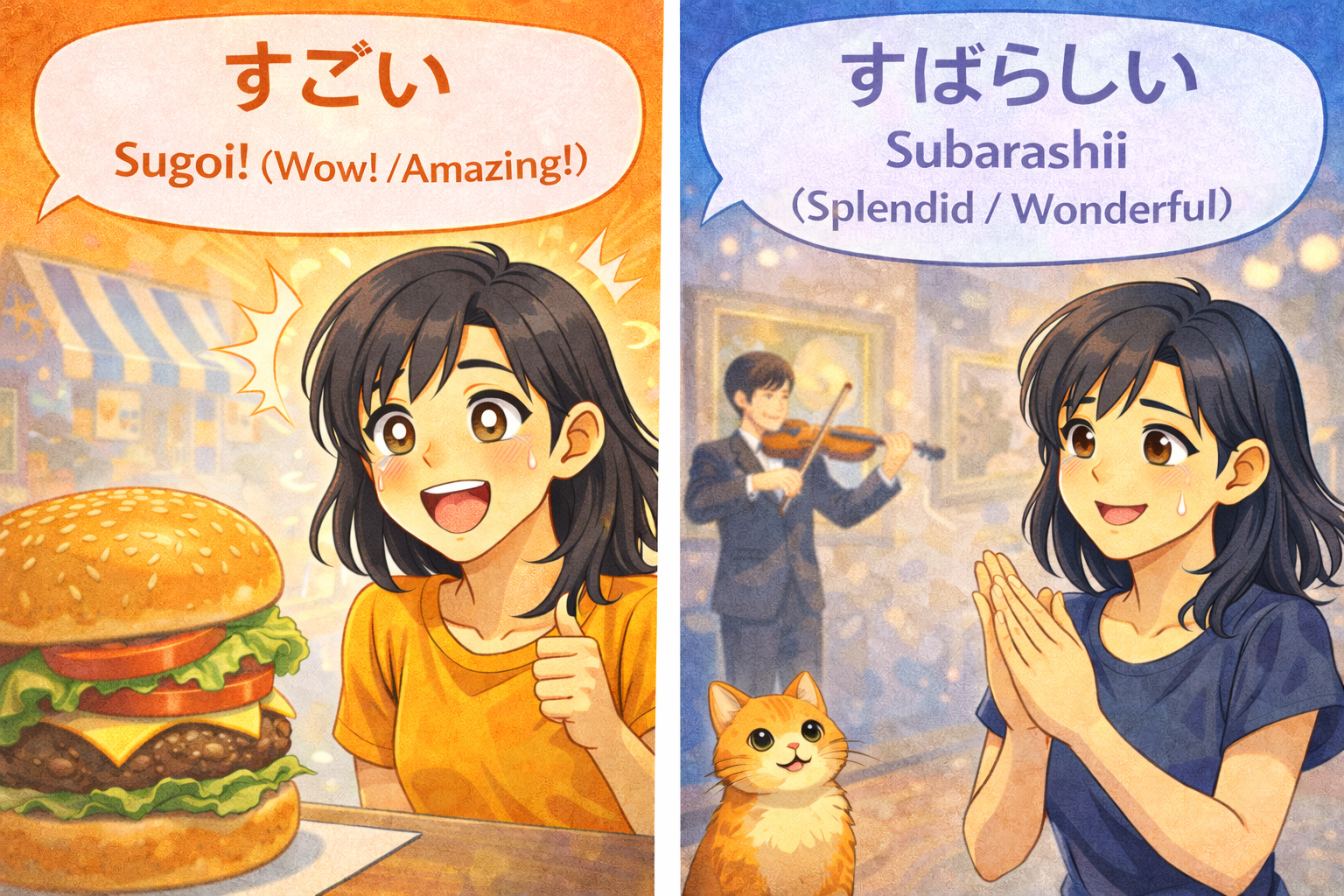
(Joy shouting “Sugoi!” casually vs. Joy saying “Subarashii” politely)
br>
(Joy shouting “Sugoi!” casually vs. Joy saying “Subarashii” politely)“Wow! That’s amazing!” “That is a splendid idea.” In Japanese, すごい (Sugoi) is casual and energetic. すばらしい (Subarashii) is polite and refined. Using them correctly changes your image completely. Let’s learn with Joy and Ken!
🗣 Conversation Scene
Joy and Ken are at a magic show.Joy
わあ!今のマジック、すごい ですね!
どうやったんですか!?
(Wow! That magic trick just now was “sugoi” (amazing)! How did he do that!?)
Ken
本当に。
技術(ぎじゅつ)も演出(えんしゅつ)も すばらしい ですね。
感動(かんどう)しました。
(Truly. The technique and the presentation are “subarashii” (splendid/excellent). I am moved.)
💡 Explanation
Gut Reaction vs. Deep AdmirationPoint 1: Sugoi (すごい) = Wow / Awesome / Terrible
Focus: Intuitive Surprise / High Degree This is a strong, visceral reaction. It is very casual. It emphasizes the “degree” of something (very big, very loud, very good).- あの選手(せんしゅ)は すごい です! (That athlete is awesome/amazing!)
- すごい 人(ひと)ですね。 (What a crowd! / That’s a huge amount of people.)
Point 2: Subarashii (すばらしい) = Splendid / Excellent
Focus: Deep Praise / High Quality This expresses deep admiration or praise for high quality. It is polite and implies value, beauty, or effort. It is purely positive.- すばらしい 演奏(えんそう)でした。 (It was a splendid musical performance.)
- あなたの考(かんガ)えは すばらしい です。 (Your idea is excellent.)
📊 Comparison Table
🚧 Joy’s Mistake
(Stuck in a huge traffic jam) ❌ Wrong: うわー、すばらしい 渋滞(じゅうたい)ですね! (Meaning: “Wow, what a SPLENDID / MAGNIFICENT traffic jam!” You sound like you are praising the traffic. It’s sarcastic or weird.) ✅ Right: うわー、すごい 渋滞ですね! (Meaning: “Wow, what a terrible / huge traffic jam!” “Sugoi” simply emphasizes the extent/degree, so it can be used for bad things too.)🔥 Practice Quiz
Tap to check the answer!Keep practicing with JPLT!
Related posts:
 Learning Japanese Requests: When to Use ‘Onegaishimasu’ vs. ‘Kudasai’
 Experience the Charm of Japanese Food! Enjoyable Dishes and Eating Tips for Beginners
 The Difference Between やさしい (yasashii) vs かんたん (kantan)|Japanese Grammar (N5–N3)
 The Difference Between「存じます」と「知っています」の違い|Japanese Grammar (N5–N3)