Skip to content
JPLT Online Japanese Language Training SchoolJPLT Online Japanese Language Training School
  • Courses
  • Plans
  • Get Started
    • What is JPLT Metaverse Campus
    • How to Enroll
  • JPLT LEARNING GYM
    • What is JPLT LEARNING GYM?
    • BootCamp
    • Studio
    • Season
    • Grammar Book
  • Schedule
  • Blog
  • About Us
    • What Is Dialog+ JPLT
    • Teachers
    • Company Profile
    • Contact Us
    • FAQs
  • Login
  • For Business
JPLT Online Japanese Language Training SchoolJPLT Online Japanese Language Training School
  • Courses
  • Plans
  • Get Started
    • What is JPLT Metaverse Campus
    • How to Enroll
  • JPLT LEARNING GYM
    • What is JPLT LEARNING GYM?
    • BootCamp
    • Studio
    • Season
    • Grammar Book
  • Schedule
  • Blog
  • About Us
    • What Is Dialog+ JPLT
    • Teachers
    • Company Profile
    • Contact Us
    • FAQs
  • Login
  • For Business
Japanese Learning TIPS

The Difference Between “計画する” (Keikaku Suru) and “予定する” (Yotei Suru) 

  • 15 Jan, 2025
  • Com 0
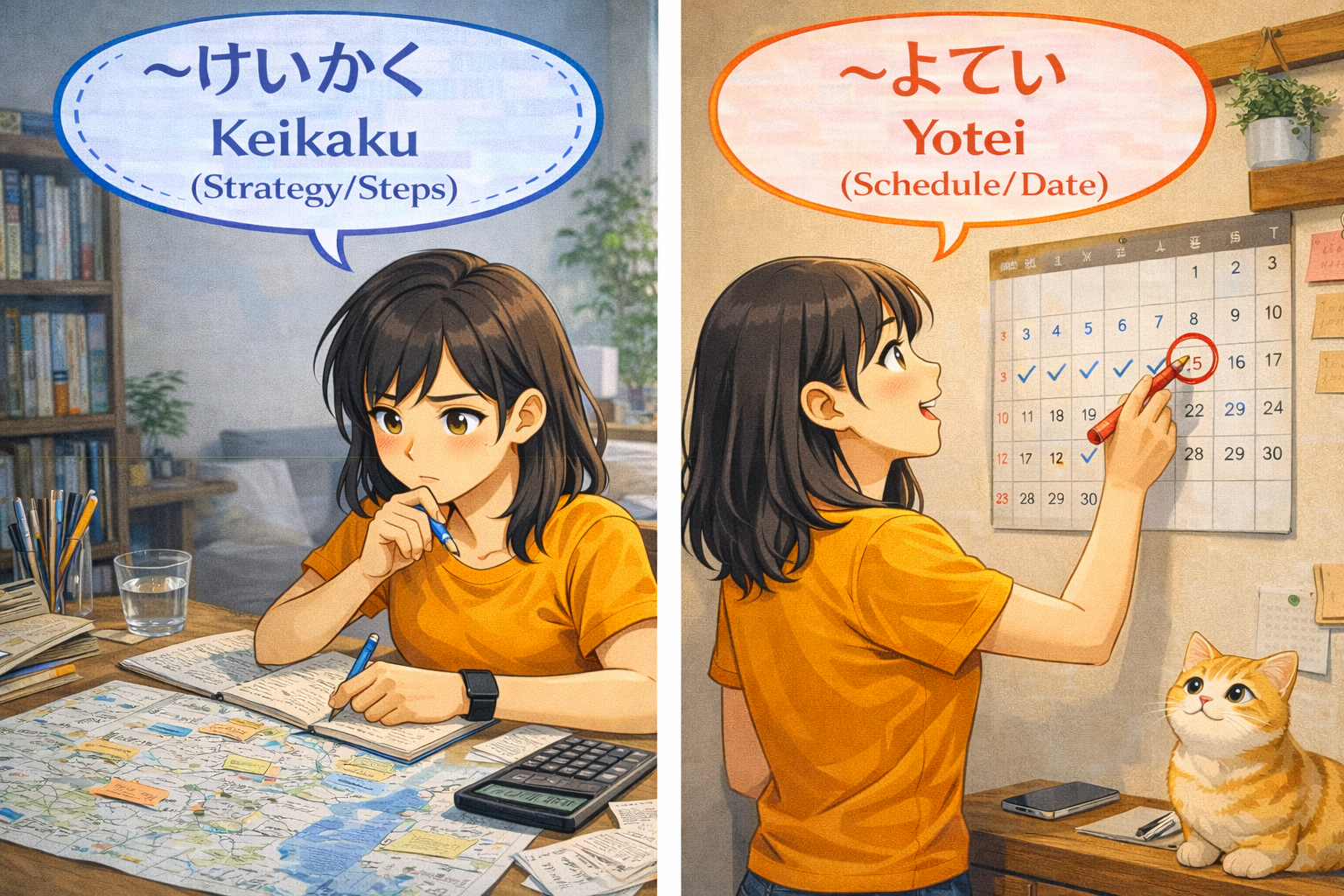
(Keikaku Suru) and “予定する” (Yotei Suru)(Joy making a detailed strategy [Keikaku] vs. Joy marking a calendar [Yotei])

“I plan to go to Japan.”
Is it 計画 (Keikaku) or 予定 (Yotei)?
In English, “Plan” covers both. But in Japanese, Keikaku is about the “How” (Strategy), and Yotei is about the “When” (Schedule). Let’s clear this up with Joy and Ken!

🗣 Conversation Scene

Joy is talking about her summer vacation.

Joy
今年の夏は、日本へ行く 予定(よてい) です!
今、どこに行くか 計画(けいかく) しています。

(I “plan/am scheduled” to go to Japan this summer! Now, I am “planning/strategizing” where to go.)
Ken
いいですね。
旅行の 計画 を立てるのは楽しいですよね。
出発(しゅっぱつ)はいつの 予定 ですか?

(Nice. Making a travel “plan/strategy” is fun. When is the “scheduled” departure?)

💡 Explanation

Think: “Blueprint” vs. “Calendar”.

Point 1: 計画 (Keikaku) = Strategy / Blueprint

Focus: Process & Effort (How?)
This implies thinking about the details, steps, budget, and methods to achieve a goal. It involves active “brain work.”

  • 計画を 立てる。
    (Make a plan / specific strategy.)
  • 都市(とし)計画。
    (City planning / Urban design.)

Point 2: 予定 (Yotei) = Schedule / Expectation

Focus: Timeline & Future (When?)
This implies that a future event is fixed or expected. It is about the “date and time.” It sounds more neutral and objective.

  • 今日の 予定は 何ですか?
    (What is your schedule for today?)
  • 3時に終わる 予定です。
    (It is scheduled/expected to finish at 3:00.)

📊 Comparison Table

Word Nuance Example
計画 (Keikaku) Process, Strategy, “How” Budget, Route, Project steps
予定 (Yotei) Schedule, Date, “When” Meeting time, Arrival date

🚧 Joy’s Mistake

(Friend asks: “Do you have plans today?”)

❌ Wrong: はい、今日は 計画(けいかく) があります。
(This sounds like: “Yes, I have a STRATEGIC PROJECT today.” It’s too heavy and grand!)

✅ Right: はい、今日は 予定(よてい) があります。
(This simply means: “Yes, I have things to do / I am busy.”)

🔥 Practice Quiz

Tap to check the answer!

Q1. The train is ______ to arrive at 10:00.
(Densha wa 10-ji ni tsuku ______ desu.)
Answer: Yotei (予定)
It is a schedule.
Q2. We need to make a detailed ______ for the project.
(Purojekuto no kuwashii ______ o tateru.)
Answer: Keikaku (計画)
It involves strategy and steps.
Q3. Everything went according to ______.
(Subete ______ doori ni itta.)
Answer: Keikaku (計画)
“Keikaku doori” (According to plan) is a common phrase when a strategy succeeds.
Keep practicing with JPLT!


Related posts:

[Must-Read Guide] Recommended Japanese Study Methods for Foreigners What Are Differences Between Formal and Informal Japanese? Are Online Japanese Lessons Effective? Explaining the Causes and Solutions Default ThumbnailLearning Japanese Requests: When to Use ‘Onegaishimasu’ vs. ‘Kudasai’
Share on:
The Difference Between "値引き" (nebiki) and "割引" (waribiki)
The Difference Between "道" (Michi), "通り" (Toori), and "道路" (Douro) 

Japanese Learning Resources:

Tips for Learning Japanese Learn Japanese with Mastery Tips Japanese Grammar Book Japanese Learning Hacks Japanese Learning FAQ (日本語) Japanese Learning FAQ (English)

Connect with us!

Inquire Now!


Latest Post

Thumb
GrammarBook N5: Nominalizers in Japanese (No /
06 Feb, 2026
Thumb
GrammarBook N5: Interrogative + か / も
06 Feb, 2026
Thumb
GrammarBook N5: Noun Modifiers in Japanese (Relative
06 Feb, 2026

Categories

  • Courses (17)
  • Grammar Book (74)
  • JAPANESE LEARNING FAQ (23)
  • Japanese Learning Hacks (9)
  • Japanese Learning TIPS (150)
  • JPLT Blog (174)
  • JPLT NEWS (11)
  • List of media productions (5)
  • にほんごをまなぶTips (146)
  • 日本語学習ハック (9)
JPLT_logo (2)

JPLT (Japanese language training) online school by Dialogplus 

Icon-facebook Icon-instagram Youtube

Dialog+ Japan
Japan Address: 2-1-1-206 Minamiyamada, Tsuzuki-ku, Yokohama Japan
Website: https://www.dialogplus.co.jp/

Dialog+ Philippines
Philippine Address: SBMA Olongapo, Zambales 
Website: https://dialogplus.ph/
Email: info@jplt-dialogplus.com

  • Specified Commercial Transaction Law
  • Privacy Policy
  • Terms & Condition
  • JPLT Calendar
  • Admin
JPLT Online Japanese Language Training SchoolJPLT Online Japanese Language Training School