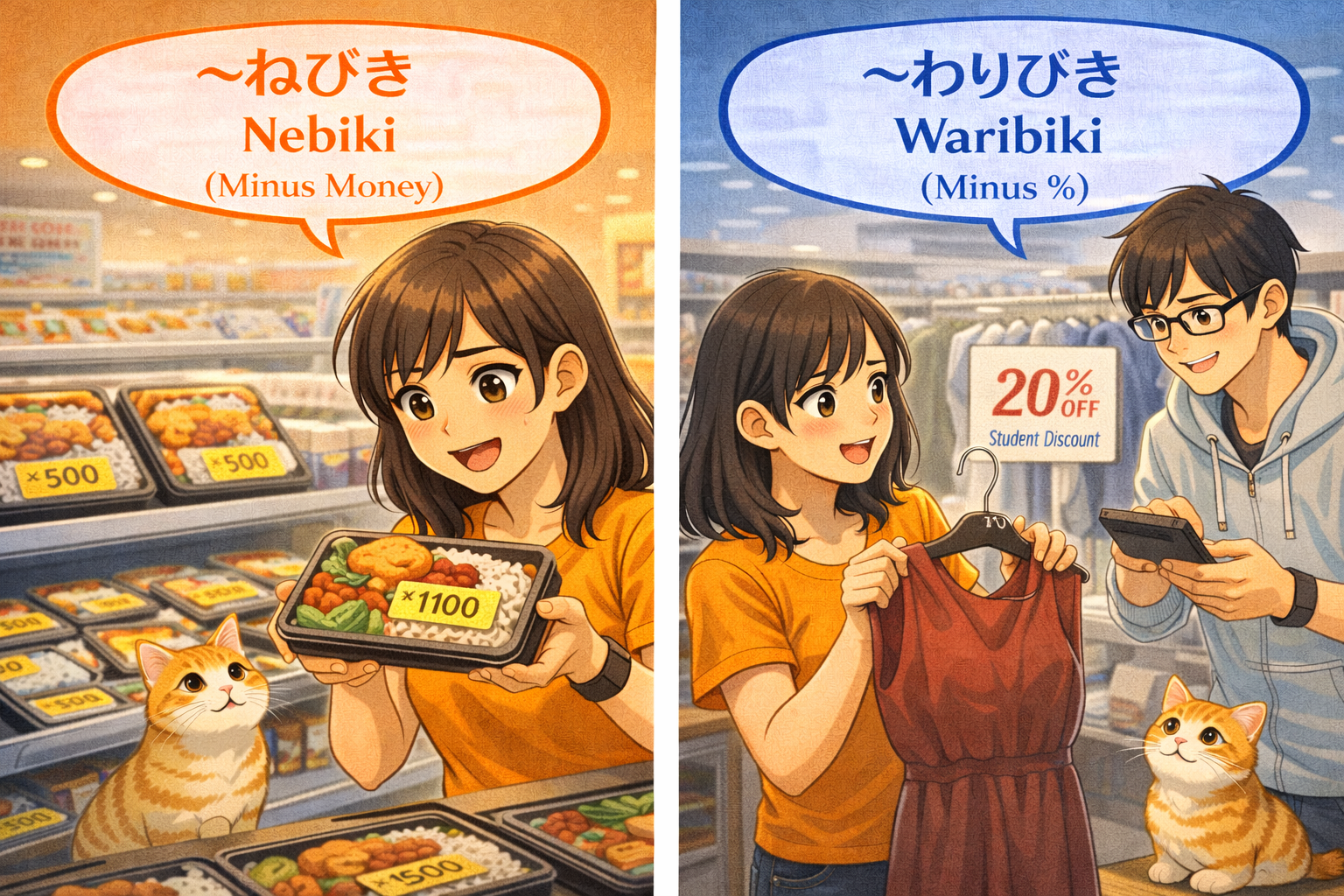
(Joy finding a clearance item [Nebiki] vs. Joy calculating a percentage sale [Waribiki])
“100 yen off!”
“20% off!”
In Japanese, we use different words depending on how the price is reduced. 値引き (Nebiki) is for money amounts, and 割引 (Waribiki) is for percentages. Let’s save money with Joy and Ken!
🗣 Conversation Scene
Joy and Ken are at a supermarket in the evening.
「50円 引(び)き」…これは割引(わりびき)ですか?
(Look! This bento has a yellow sticker. “-50 yen”… Is this “Waribiki”?)
「割引」は「20%オフ」のような、計算(けいさん)が必要な時に使いますよ。
(That is “Nebiki”. “Waribiki” is used when you need to calculate a percentage, like “20% off”.)
💡 Explanation
Money or Percentage?
Point 1: 値引き (Nebiki) = Price Reduction (Amount)
Kanji: Price (値) + Pull/Subtract (引)
You simply subtract a specific amount of money. It is often used for clearance items or haggling.
- 100円 値引き。
(100 yen off.) - 値引き してください!
(Please give me a discount! [Haggling])
Point 2: 割引 (Waribiki) = Discount (Ratio)
Kanji: Ratio/Percentage (割) + Pull/Subtract (引)
You calculate a percentage off. It implies a system or rule (Student discount, Sale campaign).
- 20パーセント 割引。
(20% off.) - 学生(がくせい)割引。
(Student discount. [Often shortened to “Gaku-wari”])
📊 Comparison Table
🚧 Joy’s Mistake
(At a flea market / garage sale)
❌ Wrong: すみません、割引(わりびき) できますか?
(Tone: “Can you apply a percentage deduction system?” This sounds too formal and mathematical for a flea market.)
✅ Right: すみません、値引き(ねびき) できますか?
(Tone: “Can you lower the price a bit?” This is the standard phrase for haggling.)
🔥 Practice Quiz
Tap to check the answer!