

「分かる(わかる)」と「理解する(りかいする)」の違い [日本語学習]
(閃いたJoy [分かる] vs データを分析するJoy [理解する]) 「あ、分かった!」と「理論(りろん)を理解しました」。 日本語(にほんご)では、「分かる (Wakaru)」は感覚的(かんかくてき)、「理解する (Rikai suru)」は論理的(ろんりてき)です。友達に「理解しました」と言うと、ロボットみたいに聞こえますよ!JoyとKenと一緒に学びましょう。 🗣 会話シーン (Conversation Scene) JoyとKenが、さっき見た難しいSF映画(えいが)について話しています。 Joy ケンさん、さっきの映画(えいが)、話(はなし)が難(むずか)しくて 理解(りかい)できません でした…。 (Ken, the movie’s plot was difficult, so I couldn’t “comprehend” it…) Ken 複雑(ふくざつ)でしたね。でも、主人公(しゅじんこう)の悲(かな)しい気持ちは...
The Difference Between 分かる (wakaru) vs 理解する (rikai suru)|Japanese Grammar (N5–N3)
(Joy having an idea [Wakaru] vs. Joy analyzing data [Rikai suru]) “I get it!” vs. “I comprehend the theory.” In Japanese, 分かる (Wakaru) is intuitive and emotional. 理解する (Rikai suru) is logical...
「持つ(もつ)」と「持っている(もっている)」の違い [日本語学習]
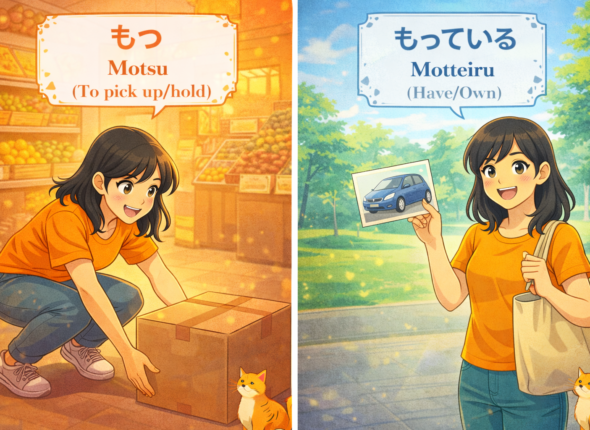
(荷物を持つJoy [持つ] vs. 車を持っているJoy [持っている]) 「ペンを持っています」「荷物を持ちます」。 日本語(にほんご)では、「持つ (Motsu)」は瞬間的(しゅんかんてき)なアクション、「持っている (Motteiru)」は継続(けいぞく)している状態(じょうたい)です。「I have a car」を「車を持ちます」と言うと変(へん)ですよ!JoyとKenと一緒に学びましょう。 🗣 会話シーン (Conversation Scene) Joyが、たくさんの荷物を持っているKenを見ています。 Joy ケンさん、荷物(にもつ)がたくさんありますね! 私(わたし)が半分(はんぶん) 持(も)ちます よ。 (Ken, you have so much luggage! I will “hold/carry” half...
The Difference Between 持つ (motsu) vs 持っている (motte iru)|Japanese Grammar (N5–N3)
(Joy picking up a box [Motsu] vs. Joy owning a car [Motteiru]) “I have a pen.” (Motteiru) “I will hold your bag.” (Motsu) In Japanese, 持つ (Motsu) is an instant action (to...
「出る(でる)」と「出す(だす)」の違い [日本語学習]
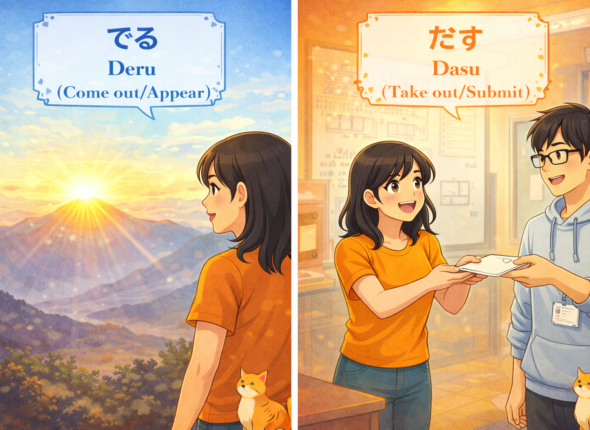
(太陽が出るJoy [出る] vs. 宿題を出すJoy [出す]) 「太陽(たいよう)が出る」と「ゴミを出す」。 似ていますが、「出る (Deru)」は自然に動くとき、「出す (Dasu)」はあなたが動かすときに使います。自動詞(じどうし)と他動詞(たどうし)の基本です。JoyとKenと一緒に学びましょう! 🗣 会話シーン (Conversation Scene) JoyとKenが教室にいます。 Joy 先生(せんせい)に 宿題(しゅくだい)を 出(だ)しました。 ケンさんは、もう 教室(きょうしつ)を 出(で)ます か? (I “submitted” my homework to the teacher. Ken, are you...
The Difference Between 出る (deru) vs 出す (dasu)|Japanese Grammar (N5–N3)
(Sun appearing [Deru] vs. Joy submitting homework [Dasu]) “The sun comes out.” (Hi ga deru) “I take out the trash.” (Gomi o dasu) They look similar, but 出る (Deru) is when something...
「入る(はいる)」と「入れる(いれる)」の違い [日本語学習]
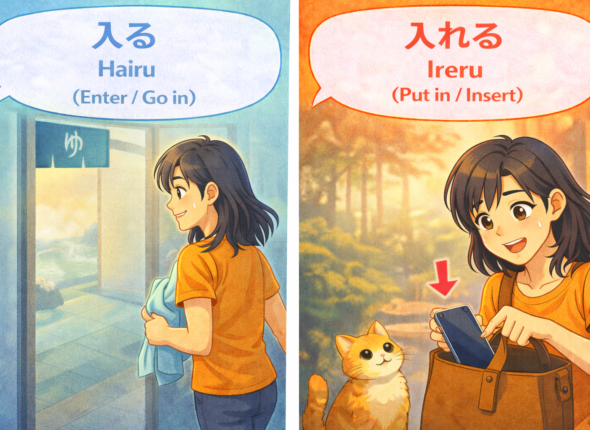
(部屋に入るJoy [入る] vs. カバンに物を入れるJoy [入れる]) 「部屋に入(はい)る。」(自分が) 「カバンに本を入(い)れる。」(物を) 同じ漢字「入」を使いますが、読み方と意味が違います。「入る (Hairu)」は自分が動くとき、「入れる (Ireru)」は物を動かすとき。JoyとKenと一緒に、自動詞(じどうし)と他動詞(たどうし)をマスターしましょう! 🗣 会話シーン (Conversation Scene) Joyが旅行の準備をしています。 Joy ケンさん、準備(じゅんび)できました! カバンに パスポートを 入(はい)りました! (Ken, I’m ready! I “entered” the passport into the bag!) Ken Joyさん、パスポートは勝手(かって)に動きませんよ(笑)...
The Difference Between 入る (hairu) vs 入れる (ireru)|Japanese Grammar (N5–N3)
(Joy entering a room [Hairu] vs. Joy putting a phone in a bag [Ireru]) “I enter the room.” (Heya ni hairu) “I put the pen in the box.” (Hako ni pen o...
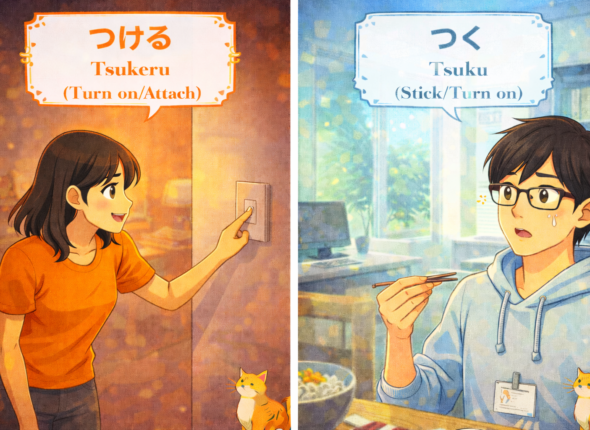
「付ける(つける)」と「付く(つく)」の違い [日本語学習]
(電気をつけるJoy [つける] vs. 顔にご飯がついているKen [つく]) 「テレビを つける」と「テレビが ついている」。 一つはあなたがするアクション、もう一つは状態(じょうたい)です。これは「他動詞(つける)」と「自動詞(つく)」の違いです。JoyとKenと一緒にマスターしましょう! 🗣 会話シーン (Conversation Scene) JoyとKenがランチを食べています。 Joy ケンさん、部屋(へや)が暗(くら)いですね。 電気(でんき)を つけましょう か? (Ken, the room is dark. Shall I “turn on” the lights?) Ken お願いします。あ、Joyさん。...
The Difference Between 付ける (tsukeru) vs 付く (tsuku)|Japanese Grammar (N5–N3)
(Joy turning on a light [Tsukeru] vs. Rice stuck on Ken’s face [Tsuku]) “I turn on the TV.” (Terebi o tsukeru) “The TV is on.” (Terebi ga tsuiteiru) One is an action...
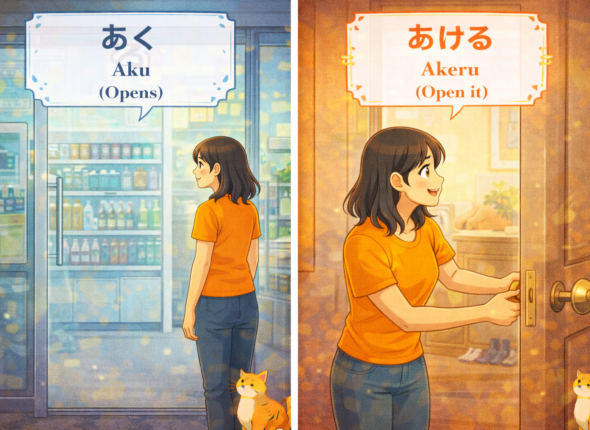
「開く(あく)」と「開ける(あける)」の違い [日本語学習]
(自動ドアが開く [開く] vs. ドアを開けるJoy [開ける]) 「ドアが 開(あ)く」と「ドアを 開(あ)ける」。 英語(えいご)ではどちらも “Open” ですが、日本語(にほんご)では使い分(わ)けます。「開く」は自然(しぜん)に動くとき、「開ける」は誰(だれ)かが動かすときです。JoyとKenと一緒にマスターしましょう! 🗣 会話シーン (Conversation Scene) JoyとKenがコンビニの前にいます。 Joy わあ、自動(じどう)ドアですね。 何もしなくても、ドアを 開(あ)けます! (Wow, an automatic door. Even if I do nothing, I “open” the...
The Difference Between 開く (aku) vs 開ける (akeru) |Japanese Grammar (N5–N3)
(Automatic door opening [Aku] vs. Joy opening a door [Akeru]) “The door opens.” (Doa ga aku) “I open the door.” (Doa o akeru) In English, the word “Open” is the same. But...
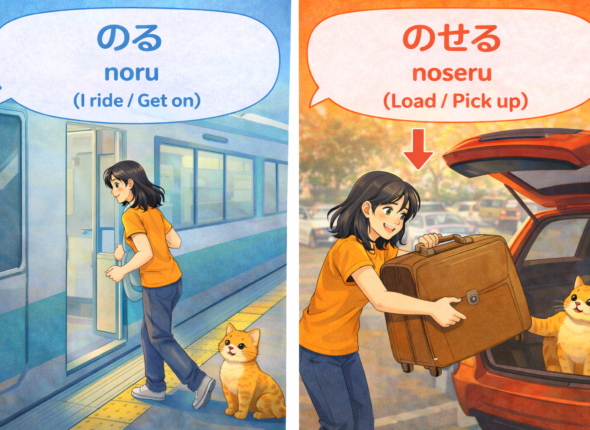
「乗る」と「乗せる」の違い [日本語学習]
(電車に乗るJoy [乗る] vs. 荷物を乗せるJoy [乗せる]) 「バスに乗(の)る。」(自分が) 「荷物を乗(の)せる。」(物を) 「乗る (Noru)」は自分が乗り物に入るとき、「乗せる (Noseru)」は物や人を乗り物に入れるときです。友達に車で送ってほしい時はどちらを使うでしょうか?JoyとKenと一緒に学びましょう! 🗣 会話シーン (Conversation Scene) Joyが空港へ行こうとしています。 Joy ケンさん、空港(くうこう)までバスに 乗(の)ります。 荷物(にもつ)が重(おも)いです…。 (Ken, I will “ride/get on” the bus to the airport. My luggage is...
The Difference Between 乗る (noru) vs 乗せる (noseru)|Japanese Grammar (N5–N3)
(Alt Text: Joy getting on a train [Noru] vs. Joy loading luggage [Noseru]) “I ride the bus.” (Basu ni noru) “I load the luggage.” (Nimotsu o noseru) 乗る (Noru) is when YOU...
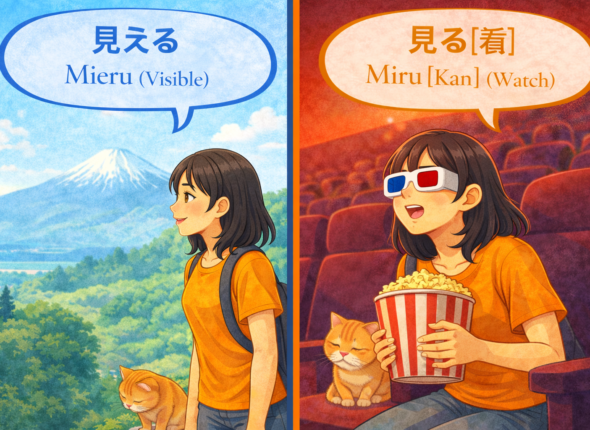
「見る」「観る」「見える」「見られる」の違い [日本語学習]
(富士山が見えるJoy [見える] vs. 映画を観るJoy [観る]) 「鳥が見える」と「映画を観る」。 「パンダが見られる」と「富士山が見える」。 日本語には「みる」の表現が4つもあります!間違えると意味が全然変わってしまいます。JoyとKenと一緒にマスターしましょう。 🗣 会話シーン (Conversation Scene) JoyとKenが山登り(やまのぼり)をしています。 Joy わあ! 富士山(ふじさん)が 見(み)えます! ケンさん、見(み)て ください! (Wow! Mt. Fuji is “visible”! Ken, please “look”!) Ken すごいですね。ここでは、珍(めずら)しい鳥(とり)も 見(み)られます よ。 後(あと)で、撮(と)ったビデオを...
The Difference Between 見る (miru) vs 観る (miru) vs 見える (mieru) vs 見られる (mirareru)|Japanese Grammar (N5–N3)
(Joy seeing Mt. Fuji [Mieru] vs. Joy watching a movie [Miru/Kan]) “I see a bird.” (Mieru) “I watch a movie.” (Miru) “I can see (have a chance to see) the panda.” (Mirareru)...
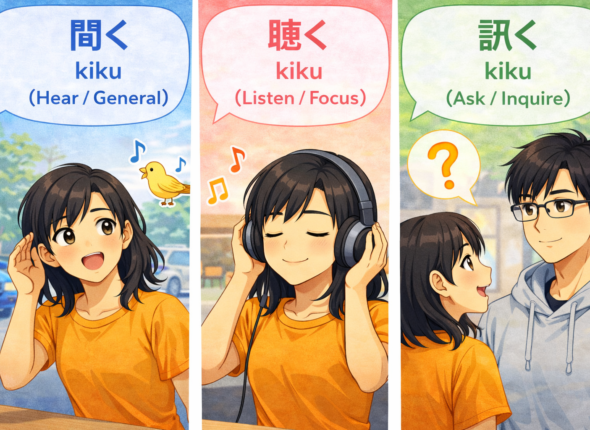
3つの「きく」の違いは?聞く・聴く・訊くの使い分け [日本語学習]
(音を聞くJoy [聞く] vs. 音楽を聴くJoy [聴く] vs. 質問するJoy [訊く]) 「音を聞く」(Hear) 「音楽を聴く」(Listen) 「名前を訊く」(Ask) 日本語では、これら全て「きく (Kiku)」と読みます!しかし、漢字によって「自然に聞こえる」のか、「集中している」のか、「質問している」のかが変わります。JoyとKenと一緒にマスターしましょう! 🗣 会話シーン (Conversation Scene) JoyとKenが街を歩いています。 Joy ケンさん、変な音が 聞こえました か? 誰かに道を 訊(き)きたい ですが…。 (Ken, did you “hear (naturally)” a strange...
Hear, Listen, or Ask? The Difference Between 聞く, 聴く, and 訊く (N3-N5)
(Joy hearing a sound [聞く], listening to music [聴く], and asking a question [訊く]) “Did you hear that?” “I listen to music.” “I ask a question.” In Japanese, all of these are...
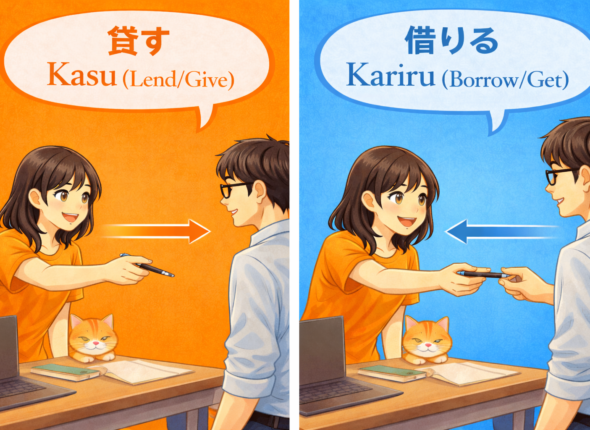
「貸す」と「借りる」の違いは?簡単な覚え方と使い方 [日本語学習]
(ペンを貸すJoy [貸す] vs. ペンを借りるJoy [借りる]) 「ペンを借(か)りてください」(間違い!) 「ペンを貸(か)してください」(正解!) 日本語の「貸す (Kasu)」と「借りる (Kariru)」。逆に使っていませんか?JoyとKenと一緒に、簡単な覚え方をマスターしましょう! 🗣 会話シーン (Conversation Scene) 雨が降っていますが、Joyは傘(かさ)を忘れました。 Joy あ、雨(あめ)ですね。傘(かさ)がありません。 ケンさん、貸(か)して ください! (Ah, it’s raining. I don’t have an umbrella. Ken, please “lend” me one!)...
What’s the Difference? 貸す (kasu) vs. 借りる (kariru) – A Simple Guide to “Lend” and “Borrow”
(Joy lending a pen [Kasu] vs. Joy borrowing a pen [Kariru]) “Please borrow me a pen.” (Mistake!) “Please lend me a pen.” (Correct!) In Japanese, 貸す (Kasu) is to lend, and 借りる...