

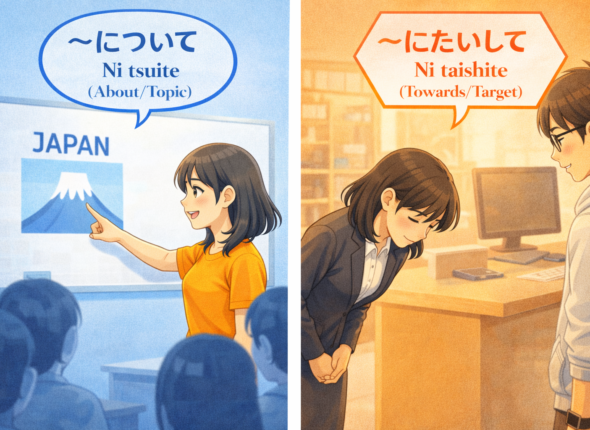
The Difference Between について (ni tsuite) vs に対して (ni taishite)|Japanese Grammar (N5–N3)
(Joy explaining a topic [Ni tsuite] vs. Joy acting towards a person [Ni taishite]) “I want to talk about you.” (Anata ni tsuite) “I am kind to you.” (Anata ni taishite) Both...
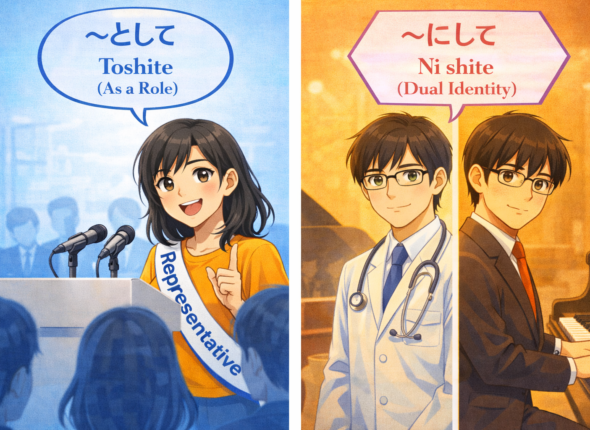
【使い分け】「として」と「にして」の違い[日本語学習]
( 代表として話すJoy [として] vs. 医者でありピアニストであるKen [にして]) 「私は友人として話します。」 「彼は天才にして努力家だ。」 どちらも名詞につきますが、ニュアンスが違います。「〜として (Toshite)」は役割(Role)、「〜にして (Ni shite)」は状態や強調(Formal State)を表します。JoyとKenと一緒に学びましょう! 🗣 会話シーン (Conversation Scene) Joyがイベントで特別ゲストを紹介しています。 Joy 今日は、JPLTの代表(だいひょう)として 挨拶(あいさつ)します。 ゲストは、社長(しゃちょう)にして プロゲーマーのケンさんです! (Today, I give a greeting “as” the representative of...
The Difference Between として (toshite) vs にして (nishite) |Japanese Grammar (N5–N3)
(Joy acting AS a representative [Toshite] vs. Ken being a doctor AND pianist [Ni shite]) “I speak as a friend.” (Tomodachi toshite) “He is a genius and a hard worker.” (Tensai ni...
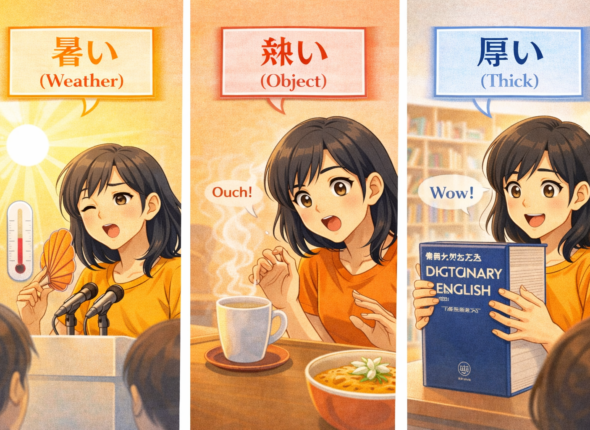
【使い分け】「暑い」「熱い」「厚い」の違い[日本語学習]
(汗をかくJoy [暑い] vs. 熱いお茶を飲むJoy [熱い] vs. 分厚い本を持つJoy [厚い]) 「今日は暑いですね。」「このお茶は熱いです。」「この本は厚いです。」日本語では、これら全て「あつい (Atsui)」と読みます!しかし、漢字は使い分けなければなりません。JoyとKenと一緒にマスターしましょう! 🗣 会話シーン (Conversation Scene) ある夏の日、Joyがカフェで勉強しています。 Joyふう、今日は 暑(あつ)い ですね。この辞書(じしょ)、厚(あつ)い から重(おも)いです…。(Phew, it is “hot (weather)” today. This dictionary is “thick”, so it’s heavy…)Kenお疲れ様です。コーヒーを買ってきましたよ。まだ 熱(あつ)い...
The Difference Between 暑い vs 熱い vs 厚い (Atsui) |Japanese Grammar (N5–N3)
br> (Joy sweating [暑い], touching hot tea [熱い], holding a thick book [厚い]) “It’s hot today.” “This tea is hot.” “This book is thick.” In Japanese, all of these are pronounced 「あつい...
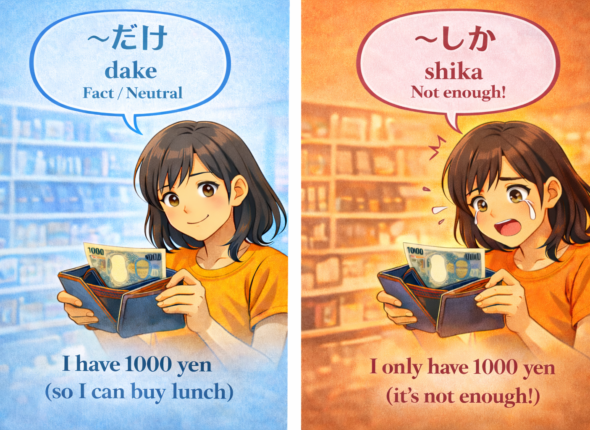
【使い分け】「だけ」と「しか」の違い[日本語学習]
(事実を話すJoy [だけ] vs. 足りないと嘆くJoy [しか]) 「10分だけあります」(事実) 「10分しかありません」(足りない!) どちらも英語では “Only” ですが、日本語では「だけ (Dake)」はニュートラル、「しか (Shika)」は感情(特に不満)が入ります。そして、文法ルールも全然違います!JoyとKenと一緒に学びましょう。 🗣 会話シーン (Conversation Scene) JoyとKenがランチの前に財布を確認しています。 Joy 私は1000円 だけ あります。 ランチに行きましょう! (I have 1000 yen. [Fact] Let’s go to lunch!) Ken...
The Difference Between だけ (dake) vs しか (shika) |Japanese Grammar (N5–N3)
(Joy stating a fact [Dake] vs. Joy complaining about lack [Shika]) “I have only 10 minutes.” (Fact) “I have nothing but 10 minutes.” (Not enough!) In Japanese, だけ (Dake) is neutral, but...
Metaverse Campus Troubleshooting
Kapag gumagamit ka ng Metaverse Campus, puwede kang makaranas ng issues tulad ng “cannot log in,” “black screen,” “walang audio/video,” o biglang nagsho-shutdown ang computer. Maraming posibleng dahilan nito—maaari itong galing sa...
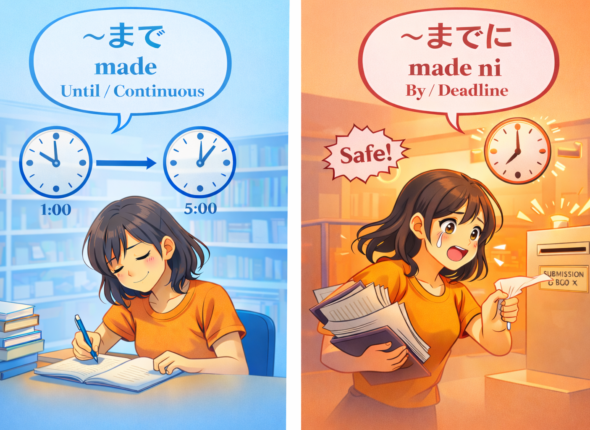
【使い分け】「まで」と「までに」の違い[日本語学習]
(5時まで勉強するJoy [まで] vs. 5時までに提出するJoy [までに]) 「5時まで待ちます。」 「5時までに終わります。」 日本語では「に (ni)」があるかないかで、意味が完全に変わります。「まで (Made)」は継続、「までに (Made ni)」は期限(Deadline)です。これを間違えると、大切な約束に遅れてしまうかもしれません!JoyとKenと一緒に学びましょう。 🗣 会話シーン (Conversation Scene) Joyは明日、レポートを出さなければなりません。 Joy ケンさん、レポートは金曜日 まで 出(だ)します! 頑張ります! (Ken, I will submit the report “continuously until” Friday! I’ll...
The Difference betweenまで (made) vs までに (made ni)|Japanese Grammar (N5–N3)
Joy studying until 5:00 [Made] vs. Joy submitting by 5:00 [Made ni]) “I will wait until 5:00.” “I will finish by 5:00.” In Japanese, just adding “ni” changes the meaning completely. 「まで...
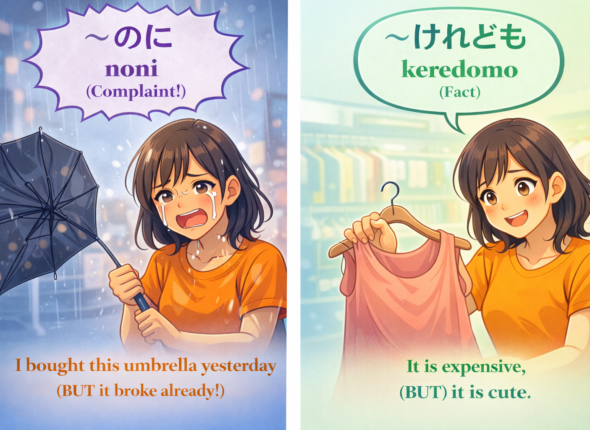
【使い分け】「のに」と「けれども」の違い[日本語学習]
( 汗をかくJoy [暑い] vs. 熱いお茶を飲むJoy [熱い] vs. 分厚い本を持つJoy [厚い]) 「今日は暑いですね。」 「このお茶は熱いです。」 「この本は厚いです。」 日本語では、これら全て「あつい (Atsui)」と読みます!しかし、漢字は使い分けなければなりません。JoyとKenと一緒にマスターしましょう! 🗣 会話シーン (Conversation Scene) ある夏の日、Joyがカフェで勉強しています。 Joy ふう、今日は 暑(あつ)い ですね。 この辞書(じしょ)、厚(あつ)い から重(おも)いです…。 (Phew, it is “hot (weather)” today. This...
The Difference Between のに (noni) vs けれども (keredomo)|Japanese Grammar (N5–N3)
] (Joy complaining about rain [Noni] vs. Joy describing a dress calmly [Keredomo]) “I studied hard, but I failed!” (Complaint) “I studied hard, but the test was difficult.” (Fact) In Japanese, のに...
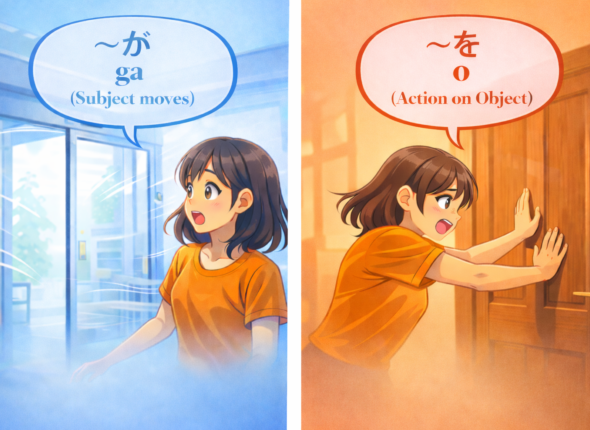
【使い分け】助詞「が」と「を」の違い[日本語学習]
(勝手に開くドア [が] vs. Joyが押すドア [を]) 「ピザを食べました」(アクション) 「ピザがあります」(存在) 助詞は難しいですね!「が (Ga)」は主語(Subject)、「を (O)」は目的語(Object)を表します。間違えると、「ピザが私を食べる」という意味になってしまいます!JoyとKenと一緒に学びましょう。 🗣 会話シーン (Conversation Scene) Joyがドアの前に立っています。 Joy ケンさん、見てください! このドアは自動(じどう)ですね。 ドア を 開(あ)きました! (Ken, look! This door is automatic. The door “opened [object marker]”!)...
The Difference Between ParticleParticle 「が」 (ga) vs 「を」 (o)|Japanese Grammar (N5–N3)
(Door opening by itself [Ga] vs. Joy pushing the door [O]) “I ate the pizza.” (Piza o tabemashita) “The pizza is here.” (Piza ga arimasu) Particles are tricky! が (Ga) marks the...
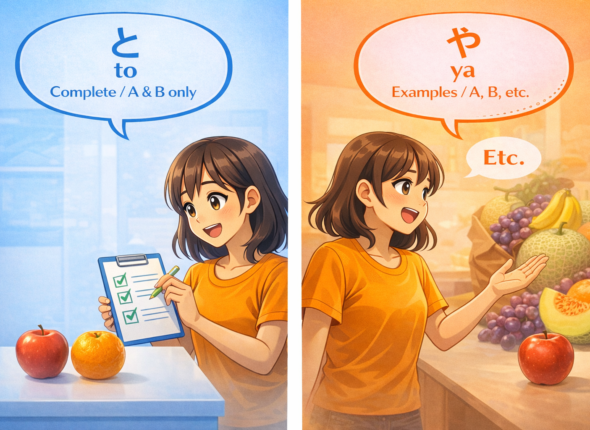
【使い分け】助詞「と」と「や」の違い[日本語学習]
(全部リストのJoy [と] vs. 例を挙げるJoy [や]) 「寿司とラーメンを食べました」(それ以外は食べていない) 「寿司やラーメンを食べました」(他にも食べたかもしれない) 日本語では、「と」を使うか「や」を使うかで、それが「全部(Complete)」なのか「ただの例(Example)」なのかが変わります。JoyとKenと一緒に、この大切なN5文法をマスターしましょう! 🗣 会話シーン (Conversation Scene) JoyがKenの買い物袋をチェックしています。 Joy ケンさん、カバンの中に何がありますか? 重(おも)そうですね。 (Ken, what’s in your bag? It looks heavy.) Ken ああ、これですか? 本(ほん)や パソコン など が入っています。 (実は、お菓子やジュースも入っています…) (Ah,...
The Difference Between Particle 「と」 (to) vs 「や」 (ya)|Japanese Grammar (N5–N3)
(Joy checking a complete list [To] vs. Joy gesturing ‘etc.’ [Ya]) “I ate sushi and ramen.” (Did you eat anything else?) In Japanese, the particle you choose tells the listener if that...
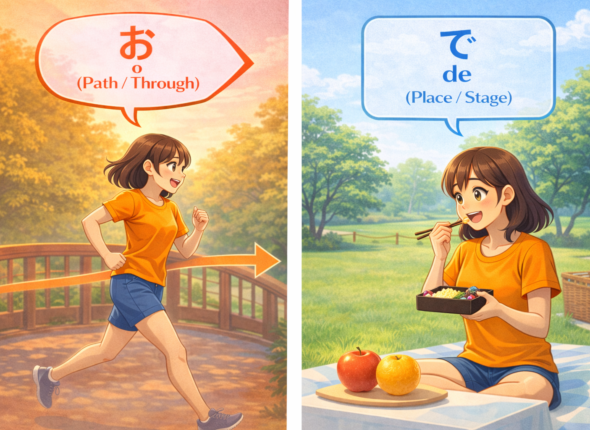
【使い分け】助詞「を」と「で」の違い[日本語学習]
(公園を通り抜けるJoy [を] vs. 公園でお弁当を食べるJoy [で]) 「公園で散歩する」?「公園を散歩する」? 普通、「を (O)」は目的語(コーヒーを飲む)に使いますが、移動する動詞と一緒に使うと「通過点(Path)」になります。一方、「で (De)」は「アクションの場所(Place)」です。JoyとKenと一緒に使い分けをマスターしましょう! 🗣 会話シーン (Conversation Scene) Joyが週末の運動について話しています。 Joy ケンさん、日曜日は散歩(さんぽ)しました。 橋(はし)で 渡(わた)って、公園 で 歩(ある)きました。 (Ken, I took a walk on Sunday. I crossed “at” the bridge...
The Difference Between「を」 (o) vs 「で」 (de)|Japanese Grammar (N5–N3)
(Joy walking THROUGH the park [O] vs. Joy eating AT the park [De]) “I walk in the park.” (Kouen de? Kouen o?) Usually, を (O) marks the Object (Coffee o nomu). But...

【使い分け】助詞「に」と「へ」の違い[日本語学習]
(到着するJoy [に] vs. 向かっているJoy [へ]) 「日本に行きます」(目的地) 「日本へ行きます」(方向) 「行く」という動詞ではどちらも正解ですが、ニュアンスが違います。「に (Ni)」は到着点(ゴール)、「へ (He)」は方向(矢印)です。JoyとKenと一緒に使い分けを学びましょう! 🗣 会話シーン (Conversation Scene) Joyがいよいよ日本へ出発します。 Joy ケンさん、いよいよ明日、日本 へ 行きます! 東京 に 着(つ)いたら、連絡しますね。 (Ken, finally tomorrow I go “towards” Japan! When I arrive...
The Difference Between「に」 (ni) vs 「へ」 (he)|Japanese Grammar (N5–N3)
(Joy arriving at a spot [Ni] vs. Joy heading towards a place [He]) “I go to Japan.” (Nihon ni ikimasu) “I go to Japan.” (Nihon he ikimasu) For verbs like “Go”, both...