

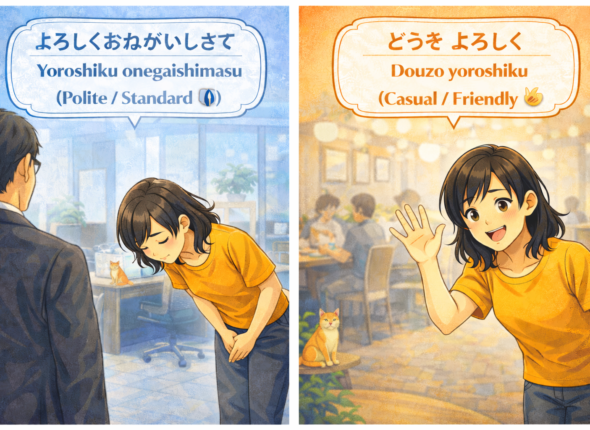
The Difference Between「よろしくお願いします」と「どうぞよろしく」の違い|Japanese Grammar (N5–N3)
(Joy bowing in an office [Yoroshiku onegaishimasu] vs. Joy waving at a party [Douzo yoroshiku]) “Nice to meet you.” -> よろしくお願いします (Yoroshiku onegaishimasu) “Nice to meet you!” -> どうぞよろしく (Douzo yoroshiku) In...
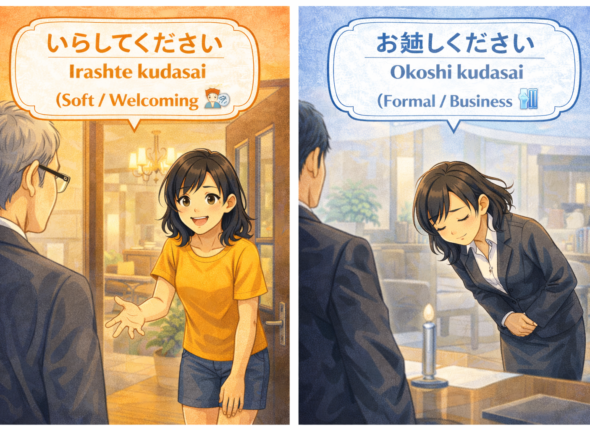
【使い分け】「お越しください」と「いらしてください」の違い[日本語学習]
(家にゲストを招くJoy [いらしてください] vs. イベントで顧客に挨拶するJoy [お越しください]) 「弊社オフィスへお越しください。」(ビジネス) 「私の家へいらしてください。」(プライベート) どちらも「来てください(Please come)」の尊敬語(Sonkeigo)ですが、ビジネスで使うか、温かく家に迎えるかで言葉が変わります。トーンの違いを理解して、ワンランク上の敬語をマスターしましょう! 🗣 会話シーン (Conversation Scene) JoyがホームパーティーにKenの両親を招待しようとしています。 Joy ケンさん、今週末(こんしゅうまつ)のホームパーティー、ぜひご両親(りょうしん)も招待(しょうたい)してください! 「私の家に お越(こ)しください」と伝(つた)えてくださいね! (Ken, please invite your parents to the home party this weekend too! Tell them:...
The Difference Between 「お越しください」と「いらしてください」の違い|Japanese Grammar (N5–N3)
(Joy welcoming a guest to her home [Irashite] vs. Joy bowing to a client at an event [Okoshi]) “Please come to our office.” -> お越しください (Okoshi kudasai) “Please come to my house.”...
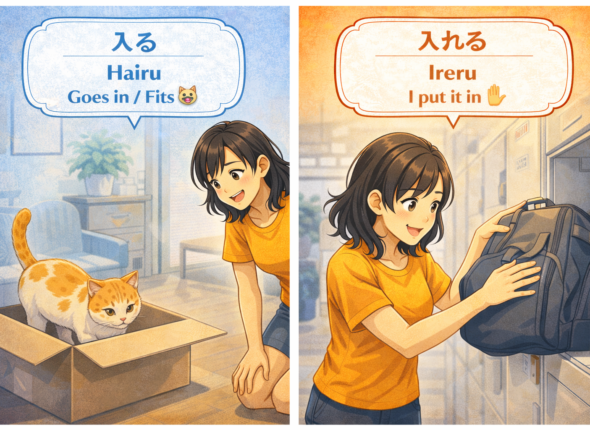
【使い分け】「入る」と「入れる」の違い[日本語学習]
(箱に入る猫 [入る] vs. ロッカーにカバンを入れるJoy [入れる]) 「猫が箱に入る。」(勝手に・自然に) 「カバンをロッカーに入れる。」(私が) 「止まる/止める」と同じように、日本語の自動詞(Intransitive)と他動詞(Transitive)の代表的なペアです。自分が空間の中へ「Enter」するときは入る (Hairu)、手に持っているものを「Put in」するときは入れる (Ireru)を使います。JoyとKenと一緒にマスターしましょう! 🗣 会話シーン (Conversation Scene) Joyが駅でコインロッカーを使おうとしています。 Joy ケンさん、見てください!私の大きいカバンが、このロッカーに 入(い)れます よ! (Ken, look! My big bag “puts into” this locker!) Ken Joyさん、カバンは自分で動けませんよ(笑)。 カバンが「入(はい)ります(Fits)」ですね。...
The Difference Between「入る」と「入れる」の違い|Japanese Grammar (N5–N3)
(Cat going into a box [Hairu] vs. Joy putting her bag in a locker [Ireru]) “The cat goes into the box.” (Neko ga hairu) “I put the bag into the locker.” (Kaban...
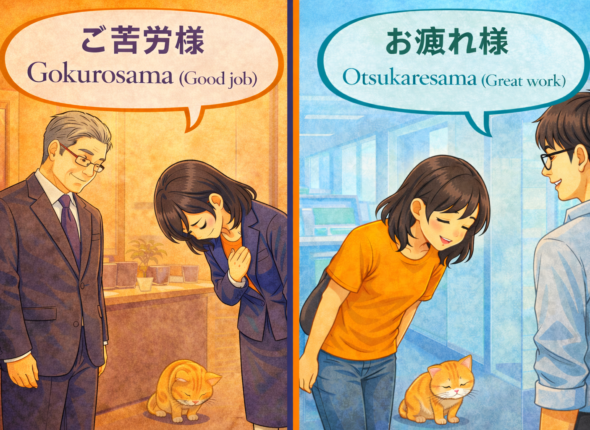
【使い分け】「ご苦労さま」と「お疲れさま」の違い[日本語学習]
(偉そうな上司 [ご苦労さま] vs. 丁寧なJoy [お疲れさま]) 「仕事が終わった!挨拶(あいさつ)は何?」 日本語には「Good job」にあたる言葉が2つあります。「ご苦労(くろう)さま」と「お疲(つか)れさま」です。これを間違(まちが)えると、上司(じょうし)を怒(おこ)らせてしまうかもしれません!JoyとKenと一緒に正しいルールを学びましょう。 🗣 会話シーン (Conversation Scene) 午後6時。Joyが仕事を終えて帰るところです。 Joy 部長(ぶちょう)、お先に失礼します。 ご苦労(くろう)さまでした! (Manager, I’m leaving now. “Good job on your toil”!) Ken ストップ!Joyさん、上司(じょうし)に「ご苦労さま」はダメですよ。 とても 偉(えら)そうに 聞こえます! (Stop! Joy,...
The Difference Between「ご苦労さま」と「お疲れさま」の違い|Japanese Grammar (N5–N3)
(Boss saying Gokurosama [Authority] vs. Joy saying Otsukaresama [Polite]) “Good work today!” In Japanese, how you say “Good job” depends on your rank. ご苦労さま (Gokurosama) is for subordinates. お疲れさま (Otsukaresama) is for...
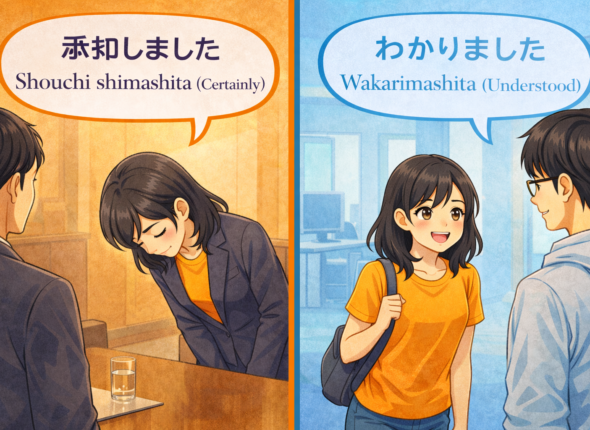
【使い分け】「承知しました」と「分かりました」の違い[日本語学習]
(上司にお辞儀するJoy [承知しました] vs. 同僚に頷くJoy [分かりました]) 「はい、理解しました」。 日常会話(にちじょうかいわ)では「分かりました (Wakarimashita)」でOKです。でも、クライアントにこれを使うと、少し頼(たよ)りなく聞こえます。プロは「承知(しょうち)しました (Shouchi shimashita)」を使います。JoyとKenと一緒に学びましょう! 🗣 会話シーン (Conversation Scene) Joyが部長(ぶちょう)から急(いそ)ぎの仕事(しごと)を頼(たの)まれています。 Ken Joyさん、この資料(しりょう)を 3時までに 修正(しゅうせい)してくれますか? 急(いそ)ぎです。 (Joy, can you correct this document by 3 PM? It’s urgent.) Joy...
The Difference Between「承知しました」と「分かりました」の違い|Japanese Grammar (N5–N3)
(Joy bowing to boss [Shouchi shimashita] vs. Joy nodding to coworker [Wakarimashita]) “I understand.” In daily life, 分かりました (Wakarimashita) is perfect. But in business, saying this to a client might make you...
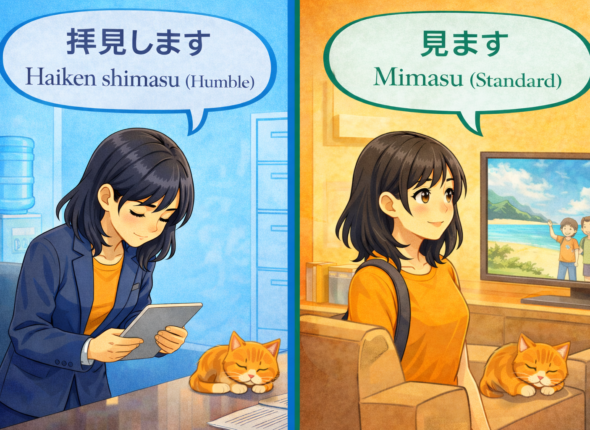
【使い分け】「拝見します」と「見ます」の違い[日本語学習]
(資料を丁寧に確認するJoy [拝見します] vs. テレビを見るJoy [見ます]) 「メールを見ました」。 ビジネスでは、この言い方は少しカジュアルすぎます。「拝見(はいけん)しました」を使いましょう。「拝見」は「謙譲語(けんじょうご)」です。JoyとKenと一緒に、正しい敬語(けいご)を学びましょう! 🗣 会話シーン (Conversation Scene) Joyが仕事のメールをチェックしています。 Joy 田中様(たなかさま)からのメールを 拝見(はいけん)しました。 すぐに返信(へんしん)します。 (I have “humbly seen/read” the email from Mr. Tanaka. I will reply immediately.) Ken ありがとうございます。 あ、Joyさん、昨日のニュースは...
The Difference Between「拝見します」と「見ます」の違い|Japanese Grammar (N5–N3)
(Joy checking a document politely [Haiken] vs. Joy watching TV [Mimasu]) “I saw your email.” In Japanese business, you cannot just say “Mimashita.” You must say 拝見しました (Haiken shimashita). This implies “I...
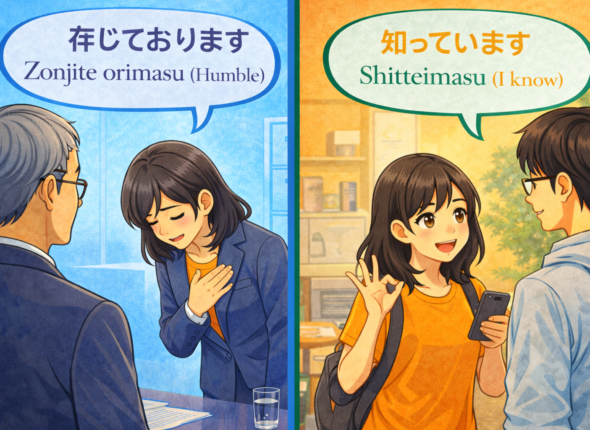
【使い分け】「存じます」と「知っています」の違い[日本語学習]
( 謙譲語を使うJoy [存じております] vs 標準語を使うJoy [知っています]) 「その件(けん)は知っています」。 お客様(きゃくさま)に「知っています」と言うと、少し子供っぽく聞こえます。ビジネスでは「存(ぞん)じております」を使(つか)いましょう。でも注意!質問(しつもん)するときに使うと失礼(しつれい)になります。JoyとKenと一緒に学びましょう! 🗣 会話シーン (Conversation Scene) Joyが電話でクライアントと話しています。 Joy はい、その件(けん)については 知(し)っています。 日程(にってい)も 分(わ)かります。 (Yes, I “know” about that matter. I “understand” the schedule too.) Ken Joyさん、お客様には 存(ぞん)じております...
The Difference Between「存じます」と「知っています」の違い|Japanese Grammar (N5–N3)
(Joy using humble Keigo [Zonjimasu] vs. Joy using standard Japanese [Shitteimasu]) “I know about that.” In Japanese business, saying “Shitteimasu” to a client can sound childish or too direct. You need to...
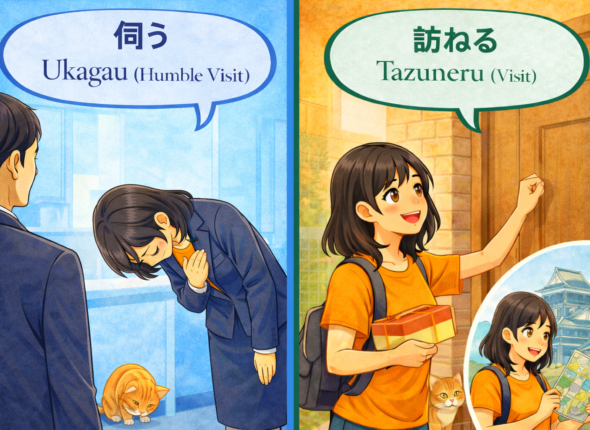
【使い分け】「伺う」と「訪ねる」の違い[日本語学習]
(クライアントを訪問するJoy [伺う] vs. 友達の家を訪ねるJoy [訪ねる]) 「明日、オフィスを訪(たず)ねます」。 これだと、少し観光(かんこう)のような軽い感じがします。ビジネスで会社に行くときは、謙譲語(けんじょうご)の「伺(うかが)います」を使いましょう。JoyとKenと一緒に学びましょう! 🗣 会話シーン (Conversation Scene) Joyが電話でお客様とアポイントを確認しています。 Joy はい、では明日(あした)の3時に、御社(おんしゃ)を 訪(たず)ねます! (Okay, I will “visit” your company at 3 PM tomorrow!) Ken ストップ!Joyさん。 お客様(きゃくさま)のところへ行くときは、伺(うかが)います を使いましょう。 (Stop! Joy. When...
The Difference Between「伺う」と「訪ねる」の違い|Japanese Grammar (N5–N3)
(Joy visiting a client [Ukagau] vs. Joy visiting a friend [Tazuneru]) “I will visit your office tomorrow.” If you say “Ashita, ofisu wo tazunemasu,” it sounds a bit like you are going...
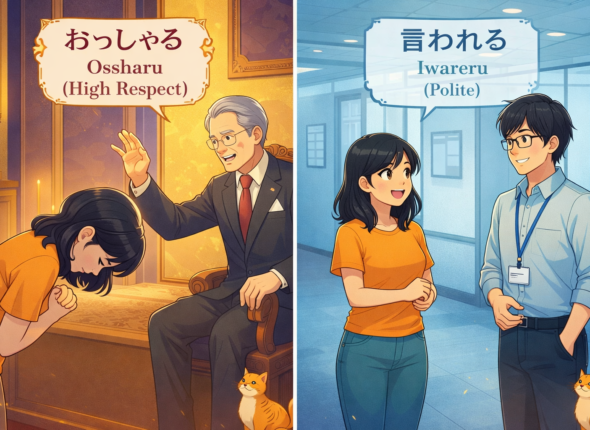
【使い分け】「おっしゃる」と「言われる」の違い[日本語学習]
( 社長の話を聞くJoy [おっしゃる] vs. 先輩の話を聞くJoy [言われる]) 「社長(しゃちょう)がおっしゃいました」「部長(ぶちょう)が言(い)われました」。 ビジネスでは、ただ「言いました」とは言えません。尊敬語(そんけいご)を使います。「おっしゃる」と「言われる」、どちらを使えばいいでしょうか?JoyとKenと一緒に学びましょう! 🗣 会話シーン (Conversation Scene) JoyがKenに、社長とのミーティングについて報告(ほうこく)しています。 Joy 社長(しゃちょう)が、「新しいプロジェクトを始める」と おっしゃいました。 (The President “said” [Honorific] that he will start a new project.) Ken そうですか。そういえば、田中(たなか)課長(かちょう)も同じことを 言(い)われていました よ。 (I...
The Difference Between 「おっしゃる」と「言われる」の違い|Japanese Grammar (N5–N3)
(Joy listening to a VIP [Ossharu] vs. Joy listening to a senior [Iwareru]) “The President said…” In Japanese business, you cannot just say “Iimashita”. You must use Honorifics (Sonkeigo). There are two...
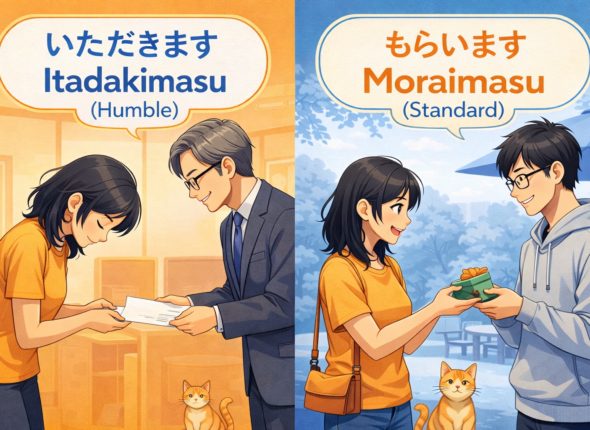
【使い分け】「いただきます」と「もらいます」の違い[日本語学習]
( 社長にお辞儀するJoy [いただきます] vs. 友達からプレゼントをもらうJoy [もらいます]) 「友達にプレゼントをもらいました」「社長に賞状(しょうじょう)をいただきました」。 どちらも「Receive」という意味ですが、リスペクトのレベルが違います。「もらいます (Moraimasu)」は標準(ひょうじゅん)、「いただきます (Itadakimasu)」は謙譲語(けんじょうご)です。JoyとKenと一緒に学びましょう! 🗣 会話シーン (Conversation Scene) JoyがKenに今日の出来事を話しています。 Joy 今日(きょう)は、友達(ともだち)に お菓子(かし)を もらいました。 そのあと、社長(しゃちょう)に お土産(みやげ)を いただきました! (Today, I “received” snacks from a friend. After that, I...
The Difference between「いただきます」と「もらいます」の違い|Japanese Grammar (N5–N3)
(Joy bowing to boss [Itadakimasu] vs. Joy getting gift from friend [Moraimasu]) “I received a gift from my friend.” vs. “I received a certificate from the President.” Both mean “Receive,” but the...
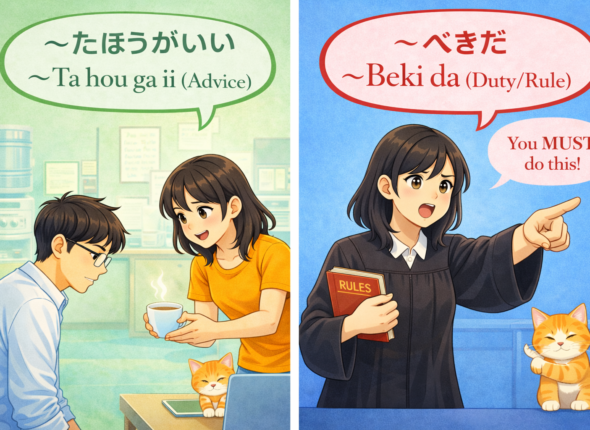
【使い分け】「〜たほうがいい」と「〜べきだ」の違い[日本語学習]
優しくアドバイスするJoy [たほうがいい] vs. 厳しくルールを言うJoy [べきだ]) 「もう帰るべきだ!」 英語の “Should” はとても便利ですが、日本語では使い分けが必要です。「〜たほうがいい (Ta hou ga ii)」はアドバイス、「〜べきだ (Beki da)」は義務です。これを間違えると、とても厳しい先生のように聞こえてしまいます。JoyとKenと一緒にニュアンスを学びましょう! 🗣 会話シーン (Conversation Scene) Kenは風邪をひいていて、咳(せき)をしています。 Joy ケンさん、顔色(かおいろ)が悪(わる)いですよ。 今日はもう、帰(かえ)ったほうがいい ですよ。 (Ken, you look pale. You “should / bad...