Skip to content
JPLT Online Japanese Language Training SchoolJPLT Online Japanese Language Training School
  • Courses
  • Plans
  • Get Started
    • What is JPLT Metaverse Campus
    • How to Enroll
  • Schedule
  • FAQs
  • Blog
  • About Us
    • What Is Dialog+ JPLT
    • Teachers
    • Company Profile
  • Contact Us
  • Login
  • For Business
JPLT Online Japanese Language Training SchoolJPLT Online Japanese Language Training School
  • Courses
  • Plans
  • Get Started
    • What is JPLT Metaverse Campus
    • How to Enroll
  • Schedule
  • FAQs
  • Blog
  • About Us
    • What Is Dialog+ JPLT
    • Teachers
    • Company Profile
  • Contact Us
  • Login
  • For Business
Japanese Learning TIPS

The Difference Between入る (hairu) vs 入れる (ireru)|Japanese Grammar (N5–N3)

  • 26 Nov, 2025
  • Com 0
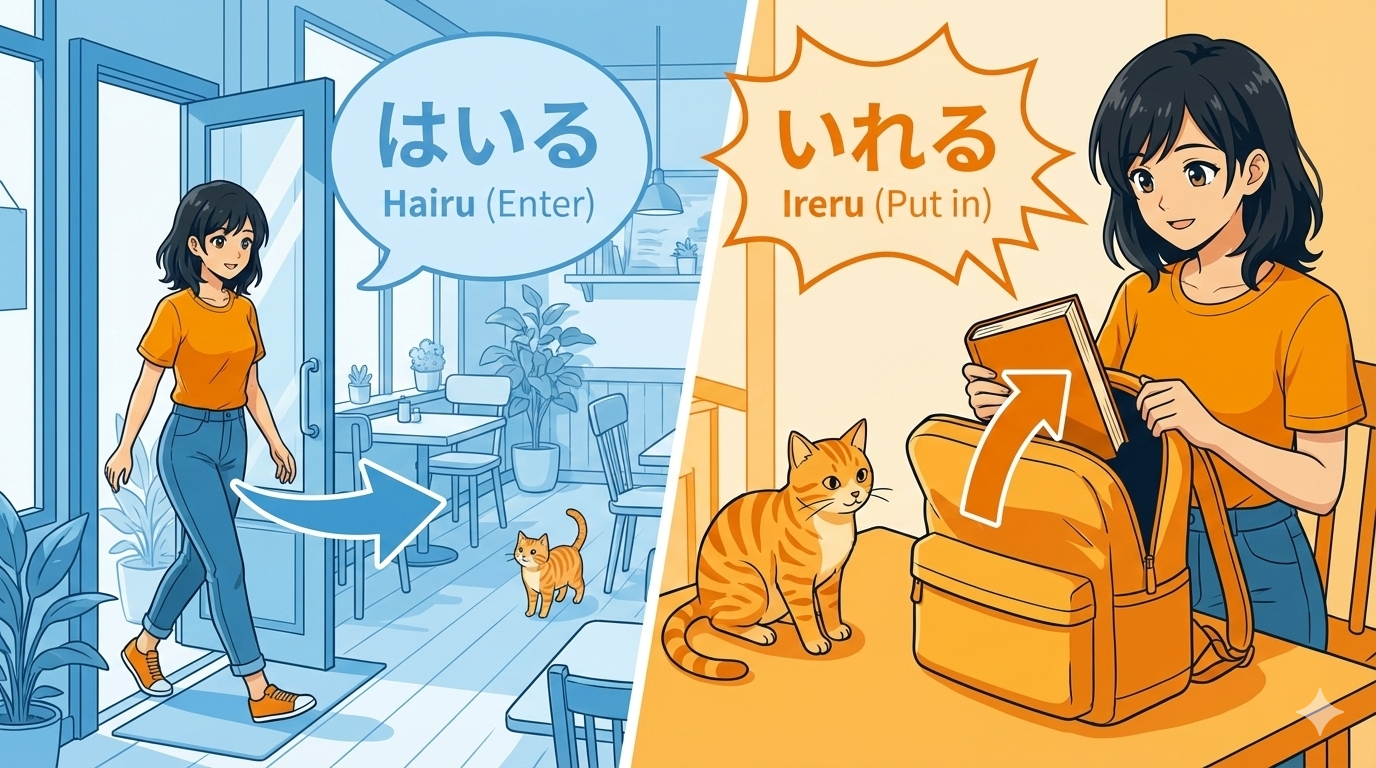
Do you want “to enter” a room? Or do you want “to put” sugar in your coffee? In Japanese, these actions use a similar but very important verb pair: 入る (hairu) and 入れる (ireru).One verb means “to enter” (by oneself), and the other means “to put in” (to make something enter). This is a very common intransitive (自動詞) and transitive (他動詞) pair that N5-N4 learners must know.

Don’t worry! This article will explain the simple difference with many examples and a practice quiz.

</header

Usage Explanation ①: 入る (hairu) – “To enter” or “To go in” (Intransitive)

First, let’s look at 入る (hairu). This is an **intransitive verb (自動詞 – jidoushi)**.

An intransitive verb describes an action that the subject does *by itself*. The subject “enters” a place.

The key particle is に (ni) to mark the place you enter. The pattern is: [Person/Thing] が [Place] に 入る。

Example 1:
猫(ねこ)が、部屋(へや)に 入る。(Neko ga, heya ni hairu.)

The cat enters the room.

Example 2:
喫茶店(きっさてん)に 入りました。(Kissa-ten ni hairimashita.)

I entered the coffee shop.

Example 3:
毎日(まいにち)、お風呂(ふろ)に 入る。(Mainichi, o-furo ni hairu.)

I take a bath every day. (I “enter” the bath.)

Key Point: Use 入る (hairu) when the subject (I, you, the cat) is the one moving and entering a place. The place is marked with に (ni).

Usage Explanation ②: 入れる (ireru) – “To put in” or “To let in” (Transitive)

Now, let’s look at 入れる (ireru). This is a **transitive verb (他動詞 – tadoushi)**.

A transitive verb describes an action that a *person* (the subject) does *to* something (the object). You “make” the object enter a place.

The key particle is を (o) to mark the object. The pattern is: [Person] が [Thing] を [Place] に 入れる。

Example 1:
私(わたし)は、砂糖(さとう)を コーヒーに 入れる。(Watashi wa, satō o kōhī ni ireru.)

I put sugar in the coffee.

Example 2:
荷物(にもつ)を かばんに 入れた。(Nimotsu o kaban ni ireta.)

I put the luggage in the bag.

Example 3:
猫(ねこ)を 部屋(へや)に 入れてください。(Neko o heya ni irete kudasai.)

Please let the cat in the room. (Please “put” the cat in the room.)

Key Point: Use 入れる (ireru) when you are taking an object (sugar, luggage, cat) and putting it *into* a place. The object is marked with を (o).

Comparison: 入る (hairu) vs 入れる (ireru)

Let’s see the difference in one simple table.

Feature 入る (hairu) 入れる (ireru)
Pronunciation ha-i-ru i-re-ru
Verb Type Intransitive (自動詞) Transitive (他動詞)
Meaning “To enter,” “to go in,” “to join” “To put in,” “to let in,” “to insert”
Who/What moves? The Subject moves itself. The Subject moves the Object.
Key Particles [Place] に (ni) [Thing] を (o), [Place] に (ni)
Example Sentence 猫(ねこ)が部屋(へや)に 入る。
(The cat enters the room.)
私(わたし)が猫(ねこ)を部屋(へや)に 入れる。
(I put the cat in the room.)

Common Mistake Examples

Mistake 1: Trying to say “Please put sugar in.”

Wrong:
砂糖(さとう)が、コーヒーに**入ってください**。(Satō ga, kōhī ni haitte kudasai.)
Correct:
砂糖(さとう)を、コーヒーに**入れてください**。(Satō o, kōhī ni irete kudasai.)
Why?
The “wrong” sentence is asking the sugar “Sugar, please enter the coffee.” This is funny, but incorrect. You are asking a *person* to do the action *to* the sugar (the object). You must use the transitive verb 入れる (ireru).

Mistake 2: Trying to say “I entered the room.”

Wrong:
私(わたし)は、部屋(へや)を 入れました。(Watashi wa, heya o iremashita.)
Correct:
私(わたし)は、部屋(へや)に 入りました。(Watashi wa, heya ni hairimashita.)
Why?
The “wrong” sentence means “I put the room in (something)…” This is impossible! *You* are the subject who is entering. You need the intransitive verb 入る (hairu) and the particle に (ni) to mark the place.

Practice Quiz

Let’s check your understanding! Choose the correct word for ( ).

Q1.

(ドアの外(そと)にいる人(ひと)に)「寒(さむ)いですから、どうぞ ( ) ください。」

(To a person outside) “It’s cold, so please ( ) .”

  1. 入って (haitte)
  2. 入れて (irete)

Q2.

彼(かれ)は、かばんに 本 ( ) 。

He ( ) a book into his bag.

  1. が 入った (ga haitta)
  2. を 入れた (o ireta)

Q3.

財布(さいふ)に、お金(かね)が ( ) いません。

There is no money ( ) my wallet.

  1. 入って (haitte)
  2. 入れて (irete)

Quiz Answers

Q1. (a) 入って (haitte) – “Please come in.” You are asking the *person* (the subject) to do the action of entering. (Intransitive)

Q2. (b) を 入れた (o ireta) – “He put the book in…” He (subject) did the action *to the book* (object). (Transitive)

Q3. (a) 入って (haitte) – “Money is not in…” This describes the *state* of the wallet. We use the intransitive verb’s -te iru form. (Intransitive)

Summary: Key Differences

How did you do on the quiz? Let’s review one last time.

  • 入る (hairu) (Intransitive – 自動詞):
    Something enters. The subject moves itself.Particle: に (ni)

    Example: 私(わたし)が部屋(へや)に 入る。(I enter the room.)

  • 入れる (ireru) (Transitive – 他動詞):
    Someone puts something in. The subject moves an object.Particle: を (o)

    Example: 私(わたし)が砂糖(さとう)を 入れる。(I put in sugar.)

Remembering this simple difference will make your Japanese sound much more natural!

Frequently Asked Questions (FAQ)

Q1: What is the simple difference between 入る (hairu) and 入れる (ireru)?
A1: The simple difference is in the action.

  • 入る (hairu) is intransitive. “Something enters.” The subject goes in by itself. (私が部屋に入る – *I* enter the room.)
  • 入れる (ireru) is transitive. “Someone puts something in.” The subject makes an object go in. (私が砂糖をコーヒーに入れる – *I* put sugar in the coffee.)
Q2: What is the opposite pair for “go out”?
A2: Yes! This pair is also very important.

  • 出る (deru) is intransitive: 私が部屋を出る。 (I go out of the room.) (Note: Uses を! This is a special case.)
  • 出す (dasu) is transitive: 私がゴミを出す。 (I take out the trash.)
Q3: What does お金が入る (okane ga hairu) mean?
A3: This uses the intransitive verb 入る (hairu). It means “Money comes in” or “I get paid.” It describes the event or state. If you say お金を入れる (okane o ireru), it uses the transitive verb and means “I put money in (e.g., a bank or wallet).”

Related Articles

  • The Difference Between 「出る (deru)」 and 「出す (dasu)」 (The “Go Out” Pair)
  • The Difference Between 「開く (aku)」 and 「開ける (akeru)」 (Another Transitive Pair)


Related posts:

[Must-Read Guide] Recommended Japanese Study Methods for Foreigners Default ThumbnailLearning Japanese Requests: When to Use ‘Onegaishimasu’ vs. ‘Kudasai’ Default ThumbnailExperience the Charm of Japanese Food! Enjoyable Dishes and Eating Tips for Beginners Default ThumbnailThe Difference Between 暑い vs 熱い vs 厚い (Atsui)|Japanese Grammar (N5–N3)
Share on:
【使い分け】「うれしい」と「たのしい」の違い[日本語学習]

Japanese Learning Resources:

Tips for Learning Japanese Learn Japanese with Mastery Tips Japanese Learning Hacks Japanese Learning FAQ (日本語) Japanese Learning FAQ (English)

Connect with us!

Inquire Now!


Latest Post

Thumb
【使い分け】「〜ながら」と「〜つつ」の違い[日本語学習]
21 Dec, 2025
Thumb
The Difference Between〜ながら (nagara) vs 〜つつ (tsutsu)|Japanese
21 Dec, 2025
Thumb
GrammarBook N5 : AはBです (A is B)
20 Dec, 2025

Categories

  • Courses (17)
  • JAPANESE LEARNING FAQ (22)
  • Japanese Learning Hacks (9)
  • Japanese Learning TIPS (135)
  • JPLT Blog (174)
  • JPLT NEWS (11)
  • List of media productions (5)
  • にほんごをまなぶTips (132)
  • 日本語学習ハック (9)
JPLT_logo (2)

JPLT (Japanese language training) online school by Dialogplus 

Icon-facebook Icon-instagram Youtube

Dialog+ Philippines
Philippine Address: SBMA Olongapo, Zambales 
Website: https://dialogplus.ph/
Email: info@jplt-dialogplus.com

Dialog+ Japan
Japan Address: Office 7F, 1-101 Sakuragicho, Naka-ku, Yokohama, Kanagawa 231-0062
Website: https://www.dialogplus.co.jp/

  • Specified Commercial Transaction Law
  • Privacy Policy
  • Terms & Condition
  • JPLT Calendar
  • Admin
JPLT Online Japanese Language Training SchoolJPLT Online Japanese Language Training School