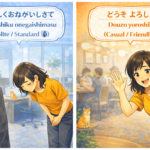
“I am polite to customers.”
In Japanese, these two sentences use different grammar points: 〜について (ni tsuite) and 〜に対して (ni taishite). They look similar because they both use “ni,” but the meaning is very different.
について = Topic (“About”, “Regarding”)
に対して = Target / Direction (“Towards”, “To”, “Against”)
This article will explain the difference simply for N3 learners.
Usage Explanation ①: 「について」 (ni tsuite) – “About” (Topic)
〜について indicates the topic or subject matter. It means “about” or “concerning.”
You use it when you are thinking, talking, writing, or studying *about* something.
Pattern: Noun + について
- Example 1: (Study topic)
- 日本(にほん)の文化(ぶんか)について 調(しら)べています。(Nihon no bunka ni tsuite shirabete imasu.)
I am researching about Japanese culture.
- Example 2: (Talking topic)
- 将来(しょうらい)の夢(ゆめ)について 話(はな)しましょう。(Shōrai no yume ni tsuite hanashimashō.)
Let’s talk about our future dreams.
- Example 3: (Asking)
- この商品(しょうひん)について 質問(しつもん)があります。(Kono shōhin ni tsuite shitsumon ga arimasu.)
I have a question regarding this product.
Key Point: Use について when the noun is the *theme* of your action (think, write, speak, ask).
Usage Explanation ②: 「に対して」 (ni taishite) – “Towards” (Target)
〜に対して indicates the target of an action, attitude, or feeling. It means “towards,” “to,” or “against.”
It is often used with words expressing attitude (polite, rude, angry, kind).
Pattern: Noun + に対して
- Example 1: (Attitude towards someone)
- 店員(てんいん)はお客(きゃく)さんに対して 丁寧(ていねい)です。(Ten’in wa okyakusan ni taishite teinei desu.)
The clerk is polite towards the customer.
- Example 2: (Action target)
- 政府(せいふ)に対して 反対(はんたい)する。(Seifu ni taishite hantai suru.)
To oppose (act against) the government.
- Example 3: (Comparison – “Whereas”)
- 昨日(きのう)は寒(さむ)かったのに対して、今日(きょう)は暑(あつ)い。(Kinō wa samukatta no ni taishite, kyō wa atsui.)
Yesterday was cold, whereas (in contrast) today is hot.
Key Point: Use に対して when you direct an emotion or action *at* someone, or when comparing two things.
Comparison: について vs に対して
Let’s check the nuance.
| Grammar | Meaning | Function | Example Verbs/Adjectives |
|---|---|---|---|
| について (ni tsuite) |
About Regarding |
Topic / Theme | 話す (talk), 考える (think), 書く (write), 調べる (research) |
| に対して (ni taishite) |
Towards Against / Whereas |
Target / Contrast | 怒る (get angry), 親切だ (kind), 厳しい (strict), 反対する (oppose) |
Common Mistake Examples
Mistake 1: “Kind about him”
- Wrong:
- 彼(かれ)について 優(やさ)しいです。(Kare ni tsuite yasashii desu.)
- Correct:
- 彼(かれ)に対して 優(やさ)しいです。(Kare ni taishite yasashii desu.)
- Why?
- You are kind *towards* a person, not *about* the topic of a person. “Yasashii” (kind) describes an attitude towards a target.
Mistake 2: “Thinking towards the problem”
- Wrong:
- この問題(もんだい)に対して 考(かんが)えています。(Kono mondai ni taishite kangaete imasu.)
- Correct:
- この問題(もんだい)について 考(かんが)えています。(Kono mondai ni tsuite kangaete imasu.)
- Why?
- Thinking involves a *topic* or *content*. You think *about* the problem. (Note: If you are taking a stance “against” a problem, ni taishite might be used, but generally ni tsuite is correct for “thinking”).
Practice Quiz
Let’s check your understanding! Choose the correct phrase.
Q1.
先生(せんせい)は、学生(がくせい) ( ) 厳(きび)しいです。
The teacher is strict ( ) the students.
- について (ni tsuite)
- に対して (ni taishite)
Q2.
日本(にほん)の歴史(れきし) ( ) 本(ほん)を書(か)きました。
I wrote a book ( ) Japanese history.
- について (ni tsuite)
- に対して (ni taishite)
Q3.
彼(かれ)の意見(いけん) ( ) どう思(おも)いますか?
What do you think ( ) his opinion?
- について (ni tsuite)
- に対して (ni taishite)
Quiz Answers
Q1. (b) に対して – Strictness is an attitude directed *towards* the students.
Q2. (a) について – History is the *topic* of the book.
Q3. (a) について – Asking about thoughts *regarding* a topic.
Summary: Key Differences
- 〜について: Topic (Think/Talk about it).
- 〜に対して: Target (Act/Feel towards it).
Think: Is it the subject matter (tsuite) or the target of emotion (taishite)?
Frequently Asked Questions (FAQ)
- Q1: Can I use “ni tsuite” for a person?
- A1: Yes. If you say “田中さんについて話す” (Talk about Tanaka-san), it means Tanaka-san is the topic of conversation. If you say “田中さんに対して話す” (Talk to/towards Tanaka-san), it means you are speaking directly to him (often with an attitude).
- Q2: Does “ni taishite” mean “contrast”?
- A2: Yes! This is another N3 meaning. “Aに対してB” can mean “In contrast to A, B is…” Example: 父は厳しいのに対して、母は優しい。(My father is strict, whereas my mother is kind.)
- Q3: What is the formal version?
- A3: Both are slightly formal, but in writing, you might see “〜につき” (ni tsuki) for “ni tsuite”, or “〜に対し” (ni taishi) for “ni taishite”.
Related Articles