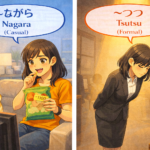
![(Alt Text: Joy giving advice [Ta hou ga ii] vs. Joy enforcing rules [Beki da])](https://jplt-dialogplus.com/wp-content/uploads/2026/01/ChatGPT-Image-Feb-9-2026-12_46_41-PM.png) (Joy giving advice [Ta hou ga ii] vs. Joy enforcing rules [Beki da])
(Joy giving advice [Ta hou ga ii] vs. Joy enforcing rules [Beki da])“You should go home.” In English, “should” is used for everything. In Japanese, we have 〜たほうがいい (Ta hou ga ii) for advice and 〜べきだ (Beki da) for duty. If you mix them up, you might sound like a strict school teacher! Let’s learn the nuance with Joy and Ken.
🗣 Conversation Scene
Ken looks very sick and is coughing.Joy
ケンさん、顔色(かおいろ)が悪(わる)いですよ。
今日はもう、帰(かえ)ったほうがいい ですよ。
(Ken, you look pale. You “should / bad better” go home for today.)
Ken
そうですね…。でも、この仕事(しごと)は今日中に終わらせる べき なんです。
(You’re right… But, I “must / have a duty to” finish this work by today.)
💡 Explanation
Is it a friendly suggestion? Or a moral rule?Point 1: ~Ta hou ga ii (〜たほうがいい) = Advice
Nuance: “It is better to…” / “I suggest…” This implies a comparison: “Doing A is better than not doing A.” It is used for giving personal advice or showing care. It is soft and helpful.- 薬(くすり)を 飲(の)んだほうがいい ですよ。 (You should take medicine. [Caring])
- タクシーで行ったほうがいい。 (It’s better to go by taxi. [Suggestion])
Point 2: ~Beki da (〜べきだ) = Duty / Obligation
Nuance: “Must” / “Ought to” / “It is the rule” This expresses strong common sense, moral obligation, or duty. It sounds very strict. Do not use this for personal preferences.- 約束(やくそく)は 守(まも)る べきだ。 (One must keep promises. [Moral rule])
- もっと 勉強(べんきょう)する べきだった。 (I should have studied more. [Regret/Self-reflection])
📊 Comparison Table
🚧 Joy’s Mistake
(Joy sees the President working late) ❌ Wrong: 社長、もう 帰(かえ)る べき です。 (Tone: “President, it is your moral duty to go home!” You sound like his mother or a judge. It is rude.) ✅ Right: 社長、もう 帰(かえ)ったほうがいい ですよ。 (Tone: “President, it would be better for your health if you went home.” This is kind advice.)🔥 Practice Quiz
Tap to check the answer!Keep practicing with JPLT!