Skip to content
JPLT Online Japanese Language Training SchoolJPLT Online Japanese Language Training School
  • Courses
  • Plans
  • Get Started
    • What is JPLT Metaverse Campus
    • How to Enroll
  • JPLT LEARNING GYM
    • What is JPLT LEARNING GYM?
    • BootCamp
    • Studio
    • Season
    • Grammar Book
    • Optional Classes and AOTD
  • Schedule
  • Blog
  • About Us
    • What Is Dialog+ JPLT
    • Teachers
    • Company Profile
    • Contact Us
    • FAQs
  • Login
  • For Business
JPLT Online Japanese Language Training SchoolJPLT Online Japanese Language Training School
  • Courses
  • Plans
  • Get Started
    • What is JPLT Metaverse Campus
    • How to Enroll
  • JPLT LEARNING GYM
    • What is JPLT LEARNING GYM?
    • BootCamp
    • Studio
    • Season
    • Grammar Book
    • Optional Classes and AOTD
  • Schedule
  • Blog
  • About Us
    • What Is Dialog+ JPLT
    • Teachers
    • Company Profile
    • Contact Us
    • FAQs
  • Login
  • For Business
Japanese Learning TIPS

“わかりません” vs. “知りません”: What’s the Difference?

  • 08 Aug, 2024
  • Com 0
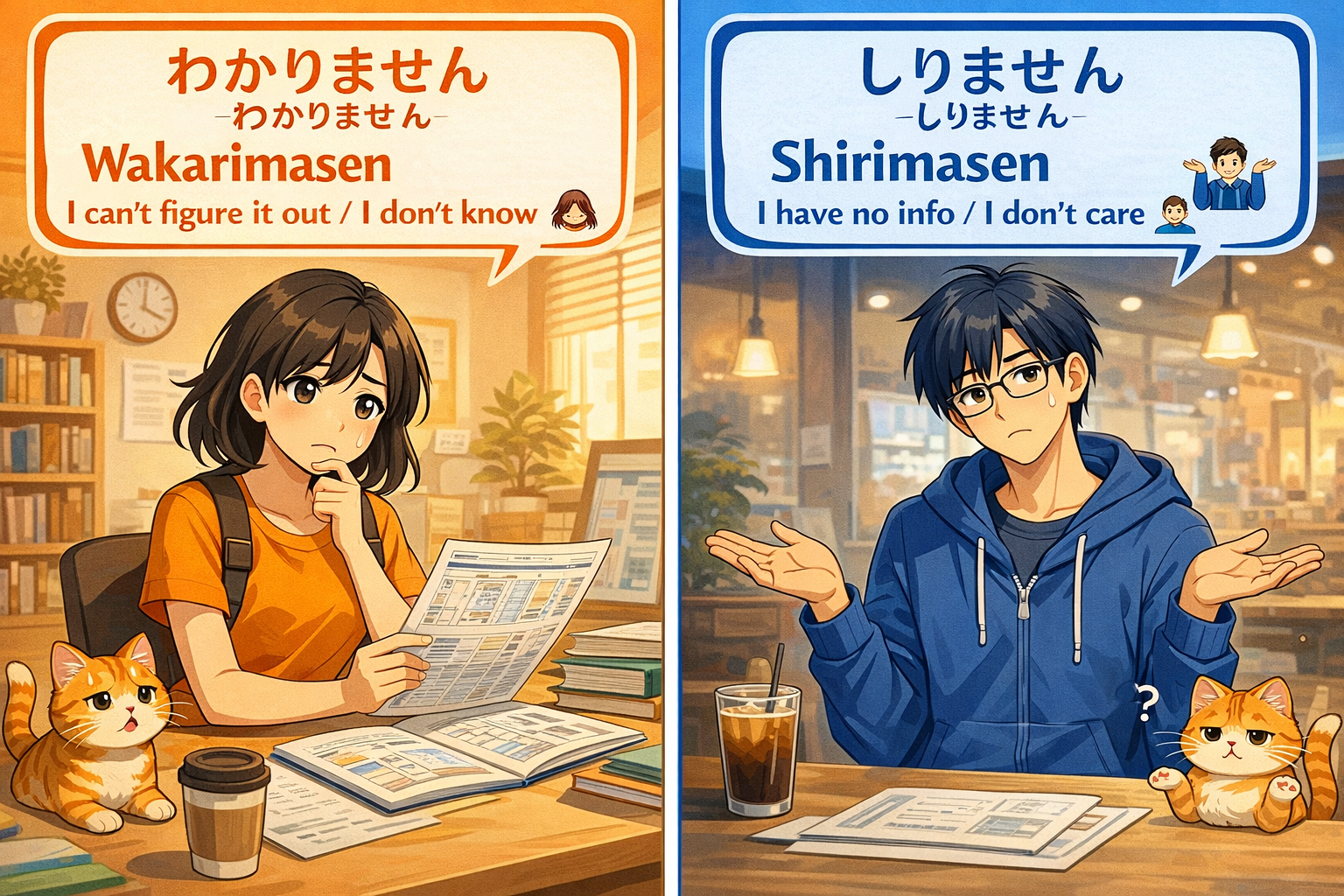
わかりません vs. 知りません
(Joy thinking hard but unable to answer [Wakarimasen] vs. Ken shrugging dismissively [Shirimasen])

“Where is the boss?” -> “Wakarimasen.” (I’m not sure.)
“Where is the boss?” -> “Shirimasen.” (I have no idea and I don’t care.)
If you look up “I don’t know” in a dictionary, you will find both わかりません (Wakarimasen) and 知りません (Shirimasen). However, using “Shirimasen” at the wrong time can make you sound incredibly cold and rude! Let’s master the safe and polite way to say “I don’t know” with Joy and Ken!

🗣 Conversation Scene

Ken is looking for their supervisor, Tanaka-san, in the office.

Ken
Joyさん、田中さんがどこにいるか、知っていますか?急ぎの書類(しょるい)があるんですが…。
(Joy, do you know where Tanaka-san is? I have an urgent document…)
Joy
いいえ、知りません。
(No, “shirimasen” [I don’t know/Not my business].)
Ken
えっ…冷たいですね😢 Joyさん、誰かの居場所(いばしょ)を聞かれた時は「わかりません」と言ったほうがいいですよ。「知りません」だと「私には関係(かんけい)ない」というニュアンスになります!
(Eh… that’s cold 😢 Joy, when someone asks where someone is, you should say “wakarimasen”! “Shirimasen” has the nuance of “It has nothing to do with me / I don’t care”!)

💡 Explanation

Processing vs. Data

⚠️ The Golden Rule of “I don’t know”:
When in doubt, always use Wakarimasen! It is the safest and most polite choice in 95% of daily situations.

1. わかりません (Wakarimasen) = I can’t figure it out / I’m not sure 🤔

Focus: Processing / Empathy
The verb *wakaru* means “to understand” or “to figure out.” When you say “wakarimasen,” it implies: “I tried to think about it, or I searched my memory, but I just can’t figure out the answer.” Because it shows you tried, it sounds very polite, soft, and empathetic.

  • [When asked a math question] すみません、わかりません。
    (Sorry, I don’t understand/can’t figure it out.)
  • [When asked for directions] すみません、道がわかりません。
    (Sorry, I don’t know the way. *Very polite*)

2. 知りません (Shirimasen) = I have zero data / Not my business 🤷‍♂️

Focus: Zero Information / Facts
The verb *shiru* means “to obtain knowledge.” When you say “shirimasen,” it is a blunt, factual statement: “I do not possess data on that topic.” Because it is so blunt, it often sounds like you are saying, “I don’t know, and I don’t care.”

  • [A detective asks you about a suspect] その人は、知りません。
    (I do not know that person. *A statement of fact/data*)
  • [When someone gossips about a celebrity] 私は 知りません。
    (I have no idea about that. *Showing lack of interest*)

📊 Comparison Table

Word Core Meaning Nuance & Impression
わかりません
(Wakarimasen)
I can’t figure it out / I’m not sure Soft & Polite. Shows you tried to think. The safest option.
知りません
(Shirimasen)
I lack the information Blunt & Factual. Can easily sound like “I don’t care.”

🚧 The “It’s Not My Fault!” Trap

There is ONE specific time you *want* to use “Shirimasen.” When someone accuses you of doing something bad, and you are 100% innocent.

Ken: Did you eat my pudding? (僕のプリン、食べましたか?)

❌ Bad (Wakarimasen): わかりません。
(Nuance: “I can’t figure out if I ate it or not.” -> You sound guilty!)

✅ Good (Shirimasen): 知りません!
(Nuance: “I have ZERO knowledge of that! I didn’t do it!”)

🔥 Practice Quiz

Tap to check the answer!

Q1. A tourist asks you where the nearest station is. You want to politely say you don’t know.
(Sumimasen, ______)
Answer: Wakarimasen (わかりません)
It shows empathy. Saying “Shirimasen” to a tourist sounds extremely rude.
Q2. A friend asks you, “Do you know that famous actor, Tanaka Taro?” You have never heard of him.
(Iie, ______)
Answer: Shirimasen (知りません)
When talking about possessing data/facts about a specific person or trivia, Shirimasen is correct.
Q3. Your boss asks, “Why is the printer broken?” You don’t know the reason.
(Sumimasen, ______)
Answer: Wakarimasen (わかりません)
“Wakarimasen” implies you can’t figure out the cause. “Shirimasen” would mean “Not my problem.”
Keep practicing with JPLT!


Related posts:

[Must-Read Guide] Recommended Japanese Study Methods for Foreigners What Are Differences Between Formal and Informal Japanese? Are Online Japanese Lessons Effective? Explaining the Causes and Solutions Understanding the Subtle Differences Between ‘Iku nara’ and ‘Iku no nara’
Share on:
6 Effective Japanese Study Methods for Beginners: Key Tips
~ませんか [~masen ka] vs. ~ましょうか [mashou ka]: What's the Difference?
JPLT Malaysia

Japanese Learning Resources:

Tips for Learning Japanese Learn Japanese with Mastery Tips Japanese Grammar Book Japanese Learning Hacks Japanese Learning FAQ (日本語) Japanese Learning FAQ (English)

Connect with us!

Inquire Now!
Send us a message to know the latest class schedules. Lessons are conducted in English and Taglish (Tagalog-English).
Please enable JavaScript in your browser to complete this form.
Name *
Loading

Latest Post

Thumb
【使い分け】「また」はいつ使う?あいまい表現の落とし穴 の違い [日本語学習]
01 Apr, 2026
Thumb
The Difference Between 「また」はいつ使う?あいまい表現の落とし穴 の違い |Japanese Grammar
01 Apr, 2026
Thumb
【使い分け】「ちょっと」は数量?それとも断り?使い分けのコツ の違い [日本語学習]
30 Mar, 2026

Categories

  • Courses (17)
  • Grammar Book (74)
  • JAPANESE LEARNING FAQ (23)
  • Japanese Learning Hacks (9)
  • Japanese Learning TIPS (156)
  • JPLT Blog (174)
  • JPLT NEWS (12)
  • List of media productions (5)
  • にほんごをまなぶTips (153)
  • 日本語学習ハック (9)
JPLT_logo (2)

JPLT (Japanese language training) online school by Dialogplus 

Icon-facebook Icon-instagram Youtube

株式会社ダイアログプラス(Dialog+ Co., Ltd.) 
神奈川県横浜市都筑区南山田二丁目1番1-206号 
Address: 2-1-1-206 Minamiyamada, Tsuzuki-ku, Yokohama Japan 
Website: https://www.dialogplus.co.jp/ 

Dialog+ Philippines
Philippine Address: Unit 7 2/F, Seung Lee Building, Lot 1 Greenwoods Park Rizal Highway, CBD Area, Subic Bay Freeport Zone, Philippines
Website: https://dialogplus.ph/
Email: info@jplt-dialogplus.com

  • Specified Commercial Transaction Law
  • Privacy Policy
  • Terms & Condition
  • Refund Policy
  • JPLT Calendar
  • Admin
JPLT Online Japanese Language Training SchoolJPLT Online Japanese Language Training School